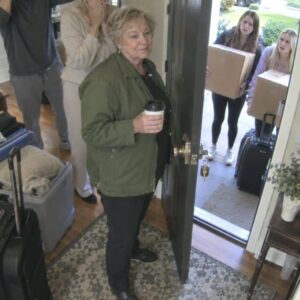
Parking on Chestnut Street had always been ordinary and legal, including the stretch in front of Linda’s large corner house, where I began leaving my car simply because it was closest. Linda, who had arrived nine years earlier and quickly assumed the role of neighborhood “quality control,” had already removed the Petersons’ ceramic flowerpots, thrown my granddaughter Sophie’s bicycle into my recycling bin, and left notes about “visual clutter,” “appropriate storage,” lawns, garage door colors, and anyone who lingered in her line of sight. When she appeared at my door, coffee cup in hand, and warned I would “regret it” if I parked in front of her house again, I apologized, explained the driveway situation, and pointed out I was within the law. She called my car a “rust bucket” that ruined her view. The next morning, a bright yellow wheel boot clamped my legally parked Honda; Linda crossed the street in her cream robe, laughing and reminding me she had warned me. I photographed everything—the boot, the car, the curb, the lack of no-parking signs, and Linda herself—then borrowed Carrie’s car and went to work, where I confirmed what I already suspected: a private citizen cannot legally immobilize a lawfully parked car on a public street. Instead of seeking punishment, I ordered two large faux-terracotta planters with trailing plants and a card: “For Linda, with my warmest regards. I wanted to contribute something beautiful to your view. Your neighbor, Margaret.” When I came home, the planters sat on her sidewalk, visible from a block away. Linda, furious, demanded to know if I had done this. I calmly explained that planters on public sidewalks, like legally parked cars on public streets, are generally allowed, mentioned the photographs I had “shared with my lawyer,” and stated I would use them if the boot ever returned. Then I named nine years of flowerpots, bicycles, notes, and complaints, and told her plainly that the neighborhood was not hers to manage and her standards were not authority.
What followed was not a dramatic transformation but a quiet shift. Linda admitted, very softly, that she should not have put the boot on my car and acknowledged she “had opinions” that people found difficult. We talked about standards: how one can hold them for oneself but not impose them on others when they are acting legally and harming no one. She asked about the plants—nasturtiums and sweet potato vine, with petunias to come—and confessed she would have overwatered them; I told her nasturtiums prefer slightly dry soil. The next day, the planters moved to the right side of her porch, where they would get morning light. Weeks passed without the boot’s return. Linda began offering a small, tentative wave from her driveway and planted the trailing plants with proper spacing. Carrie and David moved back to their renovated home, and my Honda returned to my driveway. One day, a paper bag of tulip bulbs appeared on my step with a note: “I thought you might like tulips. They do well in well-drained soil. They will come up every spring without much help. —L.” The tulips came up the following spring—this spring—red and yellow beside my driveway in the morning light. Since that February, Linda has not removed anyone’s flowerpots or thrown away bicycles. She still writes to the homeowners’ association, but now frames her concerns as questions rather than demands; neighbors adjust or don’t, and life continues. She still has opinions; I still have mine. The difference is that she now knows my limits are real, that the street is not hers, and that I will name the line when it is crossed. I know she is capable of more than entitlement; she learned to plant nasturtiums properly and left tulip bulbs signed only with an initial, a gesture that mattered. I chose planters and a conversation over a police report, not because that is always the right choice, but because we will continue to live beside each other and I cared what kind of neighbors we would be. Every spring, the tulips return “without much help,” as her note promised. The Honda remains old, rusty, and cracked, now serviced by the reasonable mechanic on Folsom Street her brother uses. The car is mine. The house is mine. Chestnut Street is ours, in the only way a street can be: shared, imperfectly, by people learning—slowly—to live beside one another.