“Mom, I think it would be better if you didn’t come Thursday.” My daughter Stephanie’s voice came through the telephone while I stood in my kitchen, tearing stale bread into pieces for the Thanksgiving dressing I’d been making for more than forty years. I stopped with both hands still inside the bread bag, waiting for her to explain what she meant. She said her new mother-in-law, Arlene Lindquist, was bringing relatives from Holdrege and Lincoln, and there simply weren’t enough places at the dining table for everyone. I counted the guests in my head and realized that twelve people had been invited to sit in twelve chairs, while the woman who owned the table had become the extra person. When I asked about the twenty-two-pound turkey I’d already delivered to Stephanie’s garage refrigerator, she assured me that she planned to cook it herself and offered to bring me a plate on Friday. I looked down at the bread scattered across my baking sheets, then at the empty space in my own dining room where the table had stood before I lent it to her in June. “That’s fine, honey,” I finally answered, because at sixty-six, I had no intention of spending Thanksgiving in a house where my presence would be regarded as an inconvenience.
My name is Roberta, and until that Sunday evening, I’d believed the old oak dining table belonged to our family’s history as much as it belonged to me. My husband, Don, and I bought it at a farm auction south of Juniata in March 1981, two years after we married. It was painted an unpleasant shade of kitchen green, and two of its eight matching chairs had cracked seats, but we paid eighty-five dollars for the entire set because it was the only substantial piece of furniture we could afford. Don drove a propane truck for the local cooperative for thirty-one years, and that spring, after finishing his routes, he spent hours in the garage stripping away the paint. Beneath it was beautiful quarter-sawn oak with a grain that reminded me of tiger stripes. With both leaves installed, the table stretched nearly ten feet and could seat twelve people if everyone was willing to share a little elbow room. Over the years, I collected four additional pressed-back chairs from auctions and secondhand shops, finally finding the twelfth in Minden in 2003. Every Thanksgiving of Stephanie’s childhood took place around that table, along with birthday dinners, celebrations, ordinary Sunday suppers, and the difficult meals after her first marriage ended. Don repaired chairs whenever they weakened, usually leaving a few penciled words beneath the seats recording what he’d fixed and who had been responsible. Four years before this Thanksgiving, he died in his sleep after a heart problem, and the house seemed to lose its purpose. I stopped eating in the dining room, preferring supper at the kitchen counter with the television playing. The long table became a place to sort bills and unopened mail. Then, last June, Stephanie married Curt Lindquist, a seed salesman based near Grand Island, and the couple bought a house on the north side of Hastings. After years in a rented duplex, my daughter finally had a dining room of her own, complete with a chandelier but no furniture. Seeing her worry about the expense of furnishing it, I offered her my oak table, its two leaves, and all twelve chairs until she and Curt found a set they liked. I made it clear that the furniture was a loan, and Stephanie gratefully accepted. In October, we agreed that Thanksgiving would be at her house. I would arrive early Thursday morning to prepare the turkey and dressing, just as I’d done throughout her life. I bought the twenty-two-pound bird myself and placed it in her spare refrigerator to thaw. The arrangements seemed settled until she called on Sunday night and explained that Arlene, Curt’s mother, was accustomed to hosting a grand family Thanksgiving and needed the big table for her relatives. I’d met Arlene only twice and knew little about her beyond the fact that she’d recently sold her farmhouse after her husband’s death. Stephanie wanted her first Thanksgiving as Curt’s wife to go well, and I understood the pressure she felt. What I could not understand was why the simplest solution had been to remove me from the guest list while keeping my furniture and the food I’d purchased. After we hung up, I finished preparing the bread because I refused to waste it, then sat alone thinking about a man named Harold from my Methodist church. His wife, Lois, had died in March after fifty-one years of marriage, and that very morning he’d told me he planned to eat Thanksgiving dinner at a roadside café because his son lived too far away to visit. I’d wished him a pleasant holiday and gone home to prepare for a gathering that no longer included me. The thought embarrassed me. On Monday morning, I called Harold and invited him to dinner at my house at one o’clock Thursday. He hesitated because he didn’t want to be anyone’s charity, so I told him I had a twenty-two-pound turkey and desperately needed help eating it. He laughed, and I realized how long it had been since I’d heard him sound happy. Then I walked into my empty dining room and looked at the four dents in the rug where Don’s table had stood.
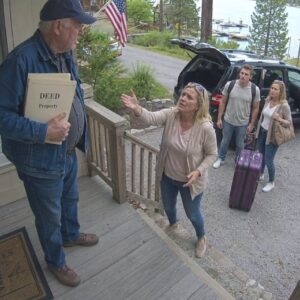
I went next door to Wayne and Donna, our neighbors of twenty-six years, and asked whether Wayne could help bring my dining furniture home. He was retired from the county roads department and still kept cattle near Ayr, so he owned a stock trailer large enough for the table and chairs. When I explained what had happened, he agreed to help, provided we wrapped the furniture carefully and removed the table legs before transporting it. Donna immediately asked what time I was serving Thanksgiving dinner, because her own children would be spending the holiday in Sioux Falls. I invited them both, and she promised sweet potatoes and green bean casserole. By Monday evening, the guest list had grown to nine after our neighbor Pat mentioned the gathering to her husband Jim and their daughter Kim, whose husband would be away working on the railroad. On Tuesday morning, I called Stephanie at the dental office where she worked and told her I’d be coming at four to collect my things. She assumed I meant the turkey and hurried off the telephone before I could explain that I meant the furniture as well. I wasn’t trying to frighten her or damage her plans, so I made sure she knew I was coming, even if she hadn’t listened closely. That afternoon, Wayne backed his truck and trailer into her driveway while I carried old comforters to protect the chairs. My fifteen-year-old grandson, Dylan, answered the door and seemed genuinely puzzled when I told him I was taking my table home because I’d been uninvited from Thanksgiving. He looked into the dining room, where Stephanie had already arranged a cream tablecloth, candles, and handwritten place cards for twelve guests. Then he looked at the twelve chairs and understood. He offered to help us pack everything, although I assured him he didn’t need to become involved in a disagreement between his mother and me. We carefully removed the place settings, folded the tablecloth, and preserved the seating cards so Stephanie could use them again. Wayne loosened the bolts holding the table legs, while Dylan and I carried the chairs outside and wrapped them in the comforters. As we worked, Dylan turned over one chair and discovered Don’s handwriting beneath the seat: “Steph’s. Reglued 11-89. She leans back.” Another chair recorded that Jim had dropped it at Easter in 1994, and one carried a reminder that I’d once stood on it to hang curtains despite knowing better. Then Dylan found the chair with a chipped rung, turned it upside down, and read the words Don had written in 2019: “Dylan. Reglued 2019. So does he.” My grandson had been eight then, and his grandfather had still been alive, quietly recording the family’s mishaps in carpenter’s pencil. Dylan held the chair for a long time, his eyes wet, before wrapping it more carefully than the others. We were nearly finished when Stephanie drove into the driveway and stared at the chairs stacked beside the trailer. She was shocked, then angry, demanding to know where she was supposed to seat the twelve people arriving in two days. I explained that I’d invited people to my own home and needed the furniture I’d lent her. She accused me of trying to punish her, but I told her I had no interest in sitting through a bitter holiday meal or forcing her to choose between relatives. I simply wanted to have Thanksgiving in my own house. When I asked whether Curt knew I hadn’t been invited, Stephanie admitted she’d told him I had other plans. Dylan quietly reminded his mother that the table belonged to me. I retrieved my turkey from the garage refrigerator, and Wayne loaded it into a cooler beside the furniture. Before leaving, I told Stephanie that my door would remain open to her, Curt, Arlene, and anyone else who wanted to come Thursday. I wasn’t canceling her dinner or asking her to disappoint her guests. I was telling her where I would be. We brought the furniture home, and Wayne and Jim reassembled the table in its familiar place, the legs fitting into the same dents in the rug. That night, I sat alone at one end and wondered whether I’d been too stubborn. I had reclaimed something that belonged to me, but I couldn’t deny that I’d hurt my daughter. Then, on Wednesday evening, Dylan called to ask whether I was making my sausage dressing and whether he might spend Thanksgiving with me. Stephanie had borrowed four mismatched card tables and was ironing a bedsheet to cover them. I knew how deeply she wanted everything to be right, so I told Dylan to ask her once more whether she truly minded him coming. When he called back, he said she’d agreed, adding that somebody from her own family ought to be at my table. I drove over to collect him, and at half past five the following morning, he was standing in my kitchen in his socks, asking what he could peel. For the first time in years, the house felt as though Thanksgiving had returned.By one o’clock Thursday afternoon, fourteen people had gathered around the oak table in my dining room. Harold came wearing a brown suit and a tie decorated with pheasants, carrying a container of cranberry relish he’d made from Lois’s handwritten recipe. Wayne and Donna arrived with vegetables, followed by Pat and Jim, Kim and her two young sons, and a couple named Amber and Tyler who had recently moved from Ohio with their baby and knew hardly anyone in Hastings. Miss Evelyn, a ninety-one-year-old retired teacher who’d once taught Stephanie, joined us, along with Ben, a college sophomore stranded in town because high winds had closed the interstate to Wyoming. With only twelve chairs, I seated the two little boys together on the piano bench, and the baby spent much of the afternoon being admired and passed from one pair of arms to another. When the food was ready, I asked Harold to say grace. He began thanking God for the meal and the people gathered around it, then fell silent when his thoughts turned to Lois. Nobody hurried him. Miss Evelyn laid a hand gently on his sleeve, and after a long pause, one of the little boys shouted “Amen” with such enthusiasm that Harold began laughing through his tears. His cranberry relish was so sour it made everyone pucker, but we ate second helpings anyway because he’d made it himself from his wife’s recipe. Dylan sat in the chair Don had repaired for him and took great care not to lean back. Looking along the crowded table, I realized that I’d spent four years avoiding my dining room because every empty chair reminded me that Don was gone. I’d lent the furniture to Stephanie because I thought it would be less painful to see the room empty than to sit alone among those memories. Yet here I was, sharing Thanksgiving with neighbors, friends, a grieving widower, young parents, and a student who couldn’t make it home. The table hadn’t lost its purpose after Don died; I’d simply forgotten how many people might need a place at it. When our guests finally left around four, Harold lingered on the porch and quietly admitted he’d been dreading Thanksgiving since his wife’s death. Dylan and I were washing dishes as evening approached when headlights swept across the kitchen window. Curt’s truck had stopped outside. I opened the door to find my daughter standing beside her husband, her eyes red from crying, while Arlene Lindquist balanced two untouched pies in her hands. She immediately apologized, explaining that she’d just learned the dinner had been arranged at my expense. We invited them inside, and over coffee they told me what had happened at Stephanie’s house. The twelve guests had eaten at four card tables of different heights beneath the ironed bedsheet. Stephanie’s turkey had been a little dry and her gravy thicker than she’d intended, but Curt’s family had been kind. Halfway through the meal, Arlene asked what had happened to the lovely oak table she’d admired during an earlier visit. Stephanie admitted it belonged to me and that I’d taken it home because I needed it. When Arlene asked why I wasn’t at Thanksgiving, Stephanie confessed that she’d uninvited me to make room for the Lindquist relatives. Arlene was appalled. She had hosted Thanksgiving for forty-three years in a farmhouse near Holdrege before selling it after her husband’s death, and she understood the pain of giving up furniture filled with family memories. She had once remarked that she missed having a large dining table, but she had never demanded Stephanie’s, much less suggested that I be excluded. My daughter, desperate to impress her new husband’s family after the failure of her first marriage, had mistaken a wistful comment for an expectation. Then she admitted something I hadn’t understood: she also wanted to cook Thanksgiving dinner herself, without me arriving early and taking over the kitchen. I had always been decisive about holiday meals, correcting her seasoning and reaching for utensils before she could finish what she was doing. I had thought I was helping, but she wanted to prove she could manage a family gathering on her own. That part of her complaint was fair, and I told her so. I also explained that she could have asked me to stay out of the kitchen without asking me to stay away from the table. Curt apologized for accepting Stephanie’s explanation that I had other plans instead of calling me directly. Then Stephanie leaned against me on the sofa and cried as she had when she was a child. I put my arm around her and apologized for the years I’d taken the spoon from her hand without recognizing what it meant. We agreed that the oak table would remain in my house, where it belonged, but that I would help her find one of her own. Dylan brought his mother into the dining room and turned over the chair Don had repaired for her in 1989. She traced her father’s penciled words with her fingertips, then read the inscription beneath Dylan’s chair and pulled her tall son into an embrace. Arlene stood beside me, looking at the worn pressed-back chairs, and quietly remarked that it was difficult to give up a table where a family had spent its life. For the first time, I called her by her first name and asked her to take off her coat. We had coffee, the pies she’d brought, and another round of turkey sandwiches. Stephanie sat down in her old chair and leaned back in it halfway through dessert, while Dylan and I exchanged a look and wisely said nothing.
The second Saturday in December, we found Stephanie and Curt a dining table of their own at an estate sale in Kenesaw. Arlene spotted it first: a round oak pedestal table with three leaves, priced at $160. Curt and Wayne hauled it home in the same stock trailer we’d used on that gray Tuesday afternoon, and Arlene and I spent several more weekends searching secondhand stores and auctions for chairs. We became better acquainted during those outings, discovering that we had much more in common than either of us had realized at the wedding. We’d both lost our husbands, both knew how unsettling it could be to live alone after years of marriage, and both loved our children fiercely enough to sometimes misunderstand what they needed. Stephanie began coming over for Sunday dinner more often, and I practiced letting her cook without supervising every movement. She took charge of the gravy, and I sat on a stool with my hands tucked beneath my legs to keep myself from reaching for the spoon. The first few times were difficult, but she became more confident, and I eventually learned that food could taste wonderful even when it hadn’t been prepared exactly my way. Harold started joining us on Sundays, sometimes bringing another recipe he’d discovered in Lois’s old kitchen drawer. Ben, the college student from Wyoming, came whenever his schedule allowed, and the young couple next door began dropping by with their baby. My dining room grew lively again, filled with conversations that weren’t always about the past. One afternoon, I took Don’s carpenter pencil from the kitchen drawer, where it had remained since his death, and turned over the chair Arlene had used on Thanksgiving. There was no inscription beneath it because the chair had never needed repairing. I wrote one anyway: “Arlene. Brought the pies.” Then I turned over my own chair and added a line beneath Don’s old handwriting: “Still doesn’t know better. But she’s learning.” I stood there looking at the words for a long time, smiling at the thought of what he might have said. Don was a quiet man, but he understood people better than I sometimes did. He’d bought that battered green table when we barely had enough money in the checking account to pay for it, then spent months restoring the wood because he believed a family ought to have somewhere to gather. Over the years, he’d fixed chairs for children who leaned too far back, guests who dropped them, and a wife who stood on them despite his warnings. He never expected the furniture to remain spotless or perfect. It was meant to be used, repaired, and filled with people. After he died, I had mistaken the emptiness around the table for proof that its best years were over. Then my daughter unintentionally pushed me to bring it home, and I discovered that there were grieving neighbors, young families, and lonely travelers who would gladly sit beside me. I don’t think Stephanie intended to be cruel when she uninvited me. She was frightened of disappointing her new family and too proud to admit she wanted to manage the holiday without my help. I was hurt, and I responded by reclaiming something that mattered deeply to me. Both of us had reasons, and both of us had things to learn. I’m grateful that we managed to talk about them before silence hardened into resentment. The oak table still stands in my dining room, its leaves extended most Sundays because somebody usually brings an extra guest. I keep the matching chairs around it, along with the penciled notes that record decades of family mishaps and ordinary affection. Sometimes I turn one over simply to read Don’s handwriting and remember the life we made together. But when I sit down now, I no longer see only the people who are missing. I see the ones who have arrived, carrying pies, homemade relish, children, and stories. And there is almost always room to pull up another chair.