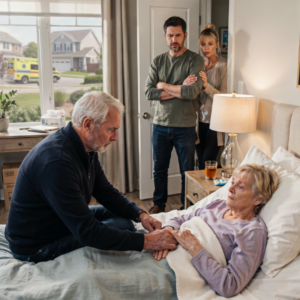
“Tom, do you think I stayed away because I blame you?” my mother-in-law asked, standing on my porch with a white envelope trembling between her hands. Behind me, the house smelled of warmed milk and unwashed dishes, and somewhere down the hallway one of my three-month-old daughters stirred in her sleep. Joan was still wearing the black wool coat she’d worn to Mary’s funeral, although the morning was warm enough for shirtsleeves. For ninety days she’d answered every photograph I sent of her granddaughters with the same two words—“Thank you”—and I’d interpreted her silence as a verdict on what happened in the delivery room. I had been the one who said, “Save the babies,” while doctors struggled to keep my wife and our unborn twins alive. I’d spent every night since wondering whether those words had cost Mary her life. But Joan looked at me with eyes red from crying and said Mary had entrusted her with a secret before the birth, something she’d promised to reveal only if the worst happened. When she finally placed the envelope on our kitchen table, I began to understand that my wife had been carrying a question about love and loss long before she became a mother.
My name is Tom Reilly, and I was thirty-six when Mary died. Until then, I taught history at the local high school and considered myself an ordinary, fortunate man who’d married someone he loved very much. We met nine years earlier in the paint aisle of a hardware store. Mary was comparing two nearly identical shades, Morning Fog and Gentle Mist, insisting that one contained more gray while I couldn’t see a difference. Her dark curls were escaping a hair clip, and there was a smear of blue paint on her cheek. I offered an opinion, she laughed at how little I understood about color, and somehow we were still talking twenty minutes later. That afternoon I noticed something about her that remained true throughout our marriage: she hated asking anyone for help. She apologized for interrupting a conversation, for asking someone to pass the salt, even for requesting a glass of water. I used to tell her that loving someone meant wanting to be needed occasionally, but she would smile and say she didn’t want to be a bother. We married two years after meeting, and I came to regard her unusual consideration for other people as simply part of her character. I knew she’d lost her father to a heart attack when she was eight. She remembered the ambulance outside their house and, more vividly, her mother’s shoes abandoned beside the front door in the rush to reach him. Mary rarely discussed the years afterward, and I assumed the subject was too painful. Her mother, Joan, had worked as a nurse before retiring. She was a precise, reserved woman who folded her napkin into a perfect square after dinner and sent handwritten thank-you notes for the smallest kindness. She visited every other Sunday, and she and Mary spoke pleasantly about recipes, neighbors, and the weather. I thought their relationship was close, if somewhat formal. I didn’t realize how much they avoided saying to each other. Mary and I tried for nearly two years to have a child. When she finally became pregnant, she sat on the edge of the bathtub holding the positive test, laughing and crying at once. At our first ultrasound, the technician announced that there were two babies, and Mary gripped my arm so tightly she left marks. We were overwhelmed and delighted. The pregnancy, however, was difficult. Mary experienced bleeding at eleven weeks, needed emergency care at nineteen weeks, and spent much of the final trimester on bed rest. She passed the time researching everything she could about twins and writing possible names on scraps of paper spread across our kitchen table. She refused to give the girls matching names because, as she told me repeatedly, they were children, not a pair of salt-and-pepper shakers. In the final weeks, her doctors were encouraged by the examinations, and we began allowing ourselves to imagine bringing two healthy daughters home. On the morning labor began, Mary wore the faded blue sweatshirt she’d bought during our first trip together, its cuffs stretched and fraying after years of use. She was still arguing cheerfully about baby names while nurses prepared the room. At nine o’clock she asked me to pass her water and immediately apologized for troubling me. I told her she never had to apologize for needing a drink. She smiled, and I remember that expression more clearly than almost anything that followed. A few hours later, serious complications developed. Alarms sounded, more medical staff entered the room, and a physician explained that the situation had become life-threatening. Mary was pale and exhausted when she reached for my hand. The doctor warned that despite every effort, they might not be able to save all three patients. Mary squeezed my fingers and said she wanted the girls protected. I wanted to argue, to demand another answer, to tell everyone to keep trying until all three could come home. But she looked directly at me and repeated her wishes, and when I spoke to the doctor, I said, “Save the babies.” The medical team continued treating Mary while delivering our daughters, but by the following morning my wife was dead. I returned home four days later with two newborn girls in separate car seats and a plastic hospital bag containing Mary’s clothes. Her blue sweatshirt was inside, still carrying the faint scent of the lavender soap she loved. I placed the bag on the top shelf of our bedroom closet and couldn’t bring myself to touch it again. Friends, colleagues, and relatives told me to stay strong for the children. My sister Kate brought casseroles and soup, bathed the girls while I showered, and quietly washed the dishes that accumulated in the sink. I tried to manage everything by making lists, writing feeding times and quantities on scraps of paper because exhaustion made it difficult to remember which daughter I’d just fed. I checked their breathing constantly, sometimes waking minutes after falling asleep simply to place a hand against each tiny chest. At night, when the house was finally quiet, I returned to the hospital room in my mind and heard myself say those three words again. I knew Mary had expressed her wishes, but grief made me imagine that a better husband might have argued harder or somehow changed the outcome. Even naming the girls felt unbearable. For more than a week I couldn’t complete their birth records, until I found two uncrossed names among Mary’s notes: June, marked with a little heart, and Ellie, accompanied by a star and a teasing comment about my tendency to think the name sounded like a cartoon elephant. I laughed for the first time since her death, then cried at the kitchen table until dawn. The next morning I gave our daughters the names their mother had chosen. June was smaller and quieter; Ellie was sturdier and seemed determined to reach for her sister whenever they lay close together. Joan attended Mary’s funeral but kept her distance, leaving the reception without speaking to me. When I sent a photograph of the twins wrapped in hospital blankets and told her their names, she replied, “Thank you.” Every subsequent photograph received the same response. Kate urged me to telephone Joan because she’d lost her only child, but my calls went unanswered. I assumed she couldn’t forgive me for agreeing to Mary’s request in the delivery room. Three months passed before Joan appeared at my door with the white envelope.
We sat at the kitchen table while the girls slept down the hall. Joan stared at the photographs and two handwritten name cards taped to our refrigerator, then began telling me about Mary’s childhood after her father’s death. She explained that she’d continued performing every practical duty of motherhood—preparing meals, washing clothes, getting Mary to school, and attending parent-teacher conferences—but had become emotionally distant. Mary resembled her father so strongly that every glimpse of his eyes or smile brought back the pain of losing him. Sometimes Joan had to leave the room because she couldn’t bear the resemblance. A few months after the funeral, eight-year-old Mary found her mother sitting in the dark with a photograph of her late husband, crying quietly. Mary climbed onto the sofa beside her and asked whether she wished her father were still alive. Joan answered that she wished it more than anything. After a pause, Mary asked whether she wished it more than she wanted her daughter. Joan told me she’d been so overwhelmed by grief that she couldn’t answer. She simply held the photograph while her little girl waited beside her. Eventually, Mary climbed down from the sofa and went back upstairs. Joan had never forgotten the moment. In the years afterward, Mary stopped bringing her drawings of her father or asking questions about him. Joan mistook the silence for recovery, but as she grew older, Mary admitted she’d learned to avoid anything that might remind her mother of what they’d lost. I sat there remembering my wife’s apologies for ordinary requests, the way she’d stand in a store rather than ask a clerk for help, and her habit of making herself as little trouble as possible. What I’d always thought was excessive politeness suddenly seemed connected to a childhood fear of being unwanted. Joan said Mary confronted her about that night shortly before our wedding. She’d apologized, and Mary had told her she understood as an adult that her mother loved her. But she’d also said she wished she’d known it when she was eight. During the pregnancy, Mary raised the subject again. She couldn’t bear the thought of her own children growing up believing they were less wanted because someone they loved had died. Joan had promised that if anything happened to Mary, she’d remain close to her granddaughters and make certain they knew they were loved. I looked at the woman sitting across from me and asked why she’d stayed away after making that promise. She lowered her head and admitted she’d been frightened that seeing June and Ellie would make her wish Mary were alive instead. She was ashamed of the thought before it had even fully formed, so she’d avoided the babies altogether. Her confession stirred a memory I’d nearly forgotten. A few weeks before the birth, Mary had been lying beside me in bed, surrounded by pillows because her growing belly made it difficult to get comfortable. One of the babies kicked so strongly that I could see the movement beneath her nightshirt. I laughed and predicted we’d have a soccer player, but Mary remained unusually serious. She asked whether, if something happened to her, I’d ever wish we hadn’t had the girls. I told her I’d miss her terribly, but I’d still love our daughters every day. She began crying against my chest. I thought the question came from pregnancy anxiety and exhaustion, so I held her until she settled and assured her that everything would be fine. Now, listening to Joan, I understood that Mary had asked the question she’d carried since childhood, only this time she was afraid for her own children. When I repeated that conversation, Joan covered her mouth and began to cry. She said my answer was what she’d failed to give Mary fifty years earlier: the assurance that missing someone desperately didn’t mean loving the people who remained any less. Then she pushed the white envelope across the table. Mary had given it to her at the baby shower, asking her to show it to me if anything happened during the pregnancy or birth. Joan had kept it for three months, unable to face the words inside. I opened the letter and recognized Mary’s handwriting, including the tiny hearts she sometimes drew above her letters. She wrote that she knew her mother had loved her, though she’d spent years believing her father’s absence was a wound her own presence couldn’t ease. She said she was frightened by what grief could make people believe and didn’t want her daughters to mistake their father’s sorrow for regret about their existence. Mary wrote that she trusted me, that I’d already helped heal something in her without knowing it, and that she wanted both our girls with all her heart. She asked her mother not to disappear from their lives and to tell me that the girls were wanted, always. Near the end was the sentence that changed how I understood those final moments in the hospital: if anything happened to her, I was not to spend the rest of my life believing I’d failed her. She had trusted me to respect what mattered most to her, and she’d wanted me to live with our daughters rather than spend my life measuring them against the wife I’d lost. For three months I’d imagined Mary looking at me in the delivery room and thinking I’d given up on her. Now I was holding proof that she’d felt something entirely different. She’d trusted me, even in the moment when neither of us could change what was happening.I read Mary’s letter twice before I could speak. Joan sat opposite me, crying quietly, while I tried to reconcile what I’d believed about my wife’s final hours with what she’d written weeks earlier. I’d replayed the hospital scene so many times that certain details had become painfully familiar: the alarms, the physician’s steady voice, Mary’s damp hair, and the strength of her grip around my hand. I had imagined that saying “Save the babies” was a decision I’d made at her expense, as though the outcome rested entirely on three words spoken by a frightened husband. But Mary’s letter reminded me that she had expressed her own wishes and that the medical team had been treating a life-threatening emergency beyond anything I could control. I couldn’t know whether any different words would have changed what happened. What I did know was that Mary had never described our daughters as a burden or a sacrifice she regretted. She’d loved them throughout the pregnancy, worried over their names, and imagined the lives they would lead. She’d wanted me to understand that her death must not become the story of what they had taken from me. I looked up at Joan and asked why she’d left us alone when she’d promised Mary she wouldn’t. Joan didn’t try to defend herself. She admitted she’d looked at photographs of the babies and seen Mary’s chin, hands, and eyes so clearly that the resemblance hurt. She imagined her daughter holding the twins, and for a moment she wished the picture were different. That wish frightened her because it recalled the childhood mistake she’d made when Mary asked whether she was wanted. Joan had feared she might feel the same terrible conflict again and somehow pass it on to her granddaughters. So she stayed away, repeating the very absence Mary had begged her not to create. I was angry. Those three months had been the loneliest of my life, filled with sleepless nights, cold meals, and the constant fear that I wasn’t capable of caring for two babies alone. Joan was a retired nurse and the girls’ grandmother. Her help could have made an enormous difference. I told her I wouldn’t pretend the silence hadn’t hurt us. But I also admitted something I’d barely allowed myself to think: sometimes I missed Mary so intensely that it was painful to look at our daughters. I’d be feeding June or rocking Ellie and suddenly think how much Mary should have been there to see their first smiles, discover their little habits, and share the ordinary surprises of parenthood. I felt guilty for having those thoughts, as though my grief suggested I didn’t love the girls enough. Joan listened, then told me that wishing Mary were alive wasn’t the same as wishing June and Ellie had never been born. I remembered the answer I’d given Mary in bed: I’d miss her every day, but I’d still love our daughters every day. Both feelings could be true at once. As we sat together, Joan explained what finally brought her to my door. The day before, I’d sent her a photograph of the twins lying on their play blanket, Ellie grinning and June gripping her sister’s sleeve. Beneath it I’d written that the girls had begun smiling when I sang. Joan remembered how Mary used to sing constantly as a child, loudly and almost always off-key, and realized she couldn’t remember the last time she’d sung with her daughter after her husband’s death. She went to the drawer where she kept Mary’s letter and read it again. Then she found two tiny yellow dresses she’d bought before the birth, still carrying their price tags, and drove to our house. She sat in the car for nearly an hour, starting the engine several times before finally gathering the courage to approach the door. What stopped her from leaving was the thought of her granddaughters growing old enough to ask why she’d never visited. She couldn’t imagine an answer that wouldn’t hurt them. Before we could say much more, Ellie woke and began crying. I went to the nursery and lifted her from the crib, only for June to wake seconds later. I settled one daughter against each shoulder and began rocking them, humming softly until their crying eased. Joan appeared in the doorway and watched us for a long moment. Then she asked whether she might hold one of the girls. I hesitated because I couldn’t bear the thought of allowing her into their lives only to have her disappear again. I told her I wouldn’t make promises on her behalf that she might not be able to keep. The girls deserved adults who would remain present even when loving them stirred painful memories. Joan nodded and said she’d earn my trust through her actions if I would give her the chance. I finally placed June in her arms. She held the smaller twin carefully, looking down at her face as though seeing Mary and someone entirely new at the same time. June reached toward her collar and curled her fingers into the wool. Joan introduced herself in a whisper, telling her she was her grandmother. That afternoon didn’t erase three months of absence, but it marked the beginning of something better. Joan returned the following morning with groceries and coffee. She came back the day after that, and the day after, washing bottles, sterilizing pacifiers, and learning the different ways the girls liked to be soothed. Ellie preferred a gentle bounce; June settled more easily when she was swayed close against someone’s chest. Joan wrote those details in her neat nurse’s handwriting and taped them to the refrigerator beside Mary’s chosen names. For the first time since the twins’ birth, I slept for four uninterrupted hours while Joan cared for them. When I woke, alarmed by the unfamiliar rest, I found her in the nursery rocking chair with both girls asleep against her and a paperback open in her lap. She told me to go back to bed, and I did. Over the next several weeks, Joan began sharing memories of Mary that I’d never heard. She brought a green leather photograph album with a cracked spine, filled with pictures of Mary as a little girl: missing front teeth, crooked birthday hats, and a photograph from a county fair where her father carried her on his shoulders. Joan told me about the day he pretended to collapse into a hay bale because Mary kept demanding another ride, making her laugh until she had hiccups. We laughed together at the kitchen table, remembering the same woman at different ages. One evening, after Joan went home, I opened the bedroom closet and took down the hospital bag I’d avoided for three months. I unfolded Mary’s blue sweatshirt, still faintly scented with lavender, and carried it into the kitchen. I placed it beside the photograph album rather than returning it to the top shelf. The next morning, Joan touched the frayed cuff and asked whether it was the sweatshirt Mary had worn to the hospital. I told her about our first trip together, when rain had trapped us in a Vermont cabin with a leaking roof and Mary insisted the weather made everything romantic. Joan smiled because that was exactly the kind of thing her daughter would have said. I admitted I’d been afraid that taking the sweatshirt out of its bag meant I was beginning to let Mary go. Joan told me it might instead be a way for June and Ellie to know her. That evening, I sat on the nursery floor between their cribs and began telling the girls stories about their mother: the paint colors she insisted were different, the songs she sang badly, the names she’d chosen, and the way she laughed on the morning they were born. They were too young to understand the words, but I wanted to begin saying them aloud. I told them their mother had wanted them before she ever saw their faces, that she’d loved them throughout the pregnancy, and that I loved them too. For the first time, I could speak about Mary without feeling that remembering her meant questioning why our daughters were alive.
The house is still quieter than it should be. Mary’s side of the bed remains empty, and there are mornings when I reach toward it before remembering she’s gone. I still notice her absence in small things: a recipe she’d have corrected, a song she’d have sung badly, or a bottle of lavender soap on a store shelf. Sometimes the grief is manageable, an ache that accompanies the day without stopping it. Other times it arrives unexpectedly and makes ordinary tasks feel almost impossible. I know I’ll miss Mary for the rest of my life, but I’ve begun to understand that missing her doesn’t mean I regret the life we created together. June and Ellie aren’t replacements for their mother, and they aren’t reminders of a bargain I made at her expense. They’re our daughters, two distinct little people who are gradually revealing their own personalities. June loves to settle against a warm chest and listen to a heartbeat. Ellie kicks her legs impatiently when she’s hungry and prefers being bounced rather than swayed. Their differences would have delighted Mary, who was so determined that they have individual names and identities rather than be treated as a matching pair. I imagine her laughing at the way Ellie reaches toward June or how they sometimes wake almost simultaneously, as though one has sent the other a signal. I wish she were here to tell me whether my observations are correct. I wish I could hand her a daughter when the crying starts and ask what she thinks might help. But I no longer confuse that wish with wanting the girls’ lives to be different. Joan has become a steady presence in our home, arriving with coffee, groceries, or something she’s remembered from Mary’s childhood. She still has difficult moments. Sometimes she’ll see one of Mary’s expressions on a baby’s face and fall silent, her eyes filling before she can stop them. But she doesn’t leave the room. She takes a breath, wipes her cheeks, and keeps holding her granddaughter. Watching her remain present despite the pain has helped me understand that grief doesn’t have to be managed by avoiding everyone who reminds us of the person we’ve lost. Joan made that mistake once with Mary, and for three months she nearly repeated it with June and Ellie. Now she has a chance to respond differently. I haven’t forgotten the loneliness of those early weeks, and I don’t believe one heartfelt conversation erases the harm of her absence. Trust is returning because she keeps showing up, not because either of us has agreed to pretend the past didn’t happen. My sister Kate still visits, bringing meals or helping with laundry, and she seems relieved to see Joan involved. Between them, I finally have moments to rest without feeling that every responsibility must be handled alone. I’ve also begun considering the grief counseling I’d avoided when the hospital first offered information about support services. For months, I treated endurance as the only measure of whether I was managing fatherhood well. I thought that if I could keep the babies fed, clean, and safe while never admitting how frightened I felt, I was doing what Mary would have wanted. But she knew better than anyone how damaging it could be to grow up around pain that nobody discussed. Her letter reminded me that love isn’t measured by silence or by the ability to pretend we’re unaffected. She’d spent much of her childhood trying not to upset her mother, learning to apologize for needs that should never have required an apology. I don’t want June and Ellie to grow up believing their feelings are burdens or that they must become small whenever someone they love is sad. I want them to know they can ask questions, make mistakes, and come to me when they’re frightened. One day they’ll be old enough to ask about the hospital and why their mother isn’t here. I’ll tell them the truth in a way they can understand, including that serious complications developed during their birth and that the doctors worked to save her. I won’t tell them their existence cost Mary her life. I’ll tell them she loved them, chose their names, bought clothes and tiny shoes, and spent months imagining what it would be like to hold them. I’ll tell them how she laughed, how she argued about paint colors, and how she apologized for asking someone to pass her a glass of water. I’ll also tell them about their grandmother, who loved Mary deeply but struggled to show it after losing her husband, and who eventually found the courage to remain present for the next generation. Mary’s letter stays in a safe place where I can read it when the old guilt begins to return. Sometimes I pause over the line where she says I had already healed something in her without knowing it. I think about that night during her pregnancy, when she asked whether I’d still want our children if something happened to her. At the time I thought I was answering an anxious question from an exhausted expectant mother. I didn’t realize I was reassuring the frightened eight-year-old she’d once been, the little girl waiting on a sofa for her mother to tell her she was wanted. I’m grateful I gave her the answer she needed, even though I didn’t understand the history behind it. I wish I’d listened more carefully when she cried, but I know now that she believed me. That knowledge doesn’t remove the grief of losing her, yet it changes what I carry alongside it. Tomorrow morning the girls will wake hungry, probably within moments of each other, and I’ll warm bottles while Joan arrives with coffee. We’ll wash dishes, compare feeding notes, and find time to talk about Mary as the day unfolds. We’ll keep the photographs where the girls can see them as they grow and tell them stories about the woman who loved them before they were born. Some days those stories will make us laugh, and some days we’ll cry. Both will be welcome in this house. Mary spent much of her life wondering whether her own presence could be enough to comfort someone who was grieving. I want our daughters to grow up knowing they never have to compete with the memory of anyone we’ve lost. They are here, they are loved, and when they ask whether we want them, they’ll never have to wait for an answer.