A very interesting.
My name is Manette Enllo, and I’m 68 years old.
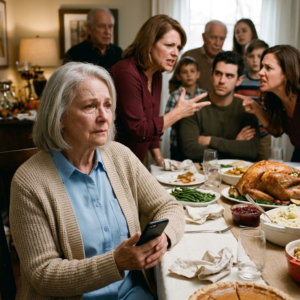
Last December, at his company’s Christmas party, my husband rested his hand on my shoulder and introduced me to a table of his new hires.
“That’s her. No job, no degree, no clue.”
The whole corner of the ballroom roared. His sister laughed the loudest, the way she always has.
I smiled because smiling is what I had done for 46 years.
Nobody else at that party knew who held the largest share of the company paying for their prime rib. My husband had spent 15 years trying to find out, and he had a name for that person.
He called them the ghost.
What happened at the Last Kettle lunch two days later, in front of more than 200 people, is why I’m telling you this.
Welcome back to Mom’s Sweet Revenge, where mothers and grandmothers who were laughed at, overlooked, and written off finally get the last word. Drop a comment telling me where you’re listening from, and be sure to subscribe.
Let me tell you who we were in October, before any of it started.
We lived on Red Fern Lane in Pennywell, Alabama, in a brick house we bought in 1987 and paid off in 2014. Pennywell sits on a bend of the Tennessee River, 45 minutes from Huntsville. It has one stoplight, four churches, and a candy factory.
And the candy factory was the reason we stayed.
My husband, Wayland, was 70. He had worked at Gerrard Candy Company for 44 years, the last 13 as executive vice president of sales and operations. He liked the title so much he put it on our Christmas card labels.
Every morning, Wayland read the paper at the kitchen table and explained it to me. Gas prices, the stock market, the weather.
That October, it was interest rates.
“It’s like a thermostat for money, Manette,” he said. “The Fed turns it up. Things cool down.”
I had spent 29 years in the trust department of a bank. I managed estates and retirement accounts worth more than our whole street.
I let him explain the thermostat anyway, and I poured his coffee and said it was very interesting.
I retired in January of 2016 at 57. After that, I gardened and sang alto in the Methodist choir.
Once every quarter, I drove to Huntsville for what I called a standing lunch with a friend. Wayland never asked which friend, and for 15 years, that suited us both.
Our daughter, Dedra, lived in Denver. She called every Sunday at 4:00, and she always asked about her dad first.
“He’s saving the company again,” I’d tell her.
That October, Wayland started coming home late. He started humming in the shower, too, which he hadn’t done since the first Bush administration.
You need to know a little about Gerrard Candy because the whole town does.
F. Gerrard started it in 1958 in a tin building by the river. He made ribbon candy, peanut brittle, divinity, and chocolate-covered cherries. And the company still makes all four.
About 210 people work there year-round, and every fall, the whole town smells like scorched sugar and peppermint.
The founder’s copper kettle still hangs in the packing hall on an iron frame by the loading door. Everybody calls it Kettle Number One. It hasn’t cooked a batch since 1994, but it still has one job.
On the last production day before the Christmas shutdown, the company holds a lunch called Last Kettle. The longest-serving kettleman strikes that copper pot with a wooden paddle. Then the family hands out the bonus envelopes.
In 2012, the year he became an executive vice president, Wayland asked to strike it.
The founder’s widow, Lavell, said no.
“It’s for the kettlemen,” she told him.
And he never forgave her for it.
Wayland told everyone he had saved Gerrard Candy in 2010. Sugar prices went through the roof that year, and the bank called the company’s loan. He said he worked 80-hour weeks and kept the doors open.
The doors did stay open.
A new investor bought almost half the company that summer. Outside of two or three people, nobody ever learned who it was.
The shares sat in something called Calico Holdings, and the owner never came to a single meeting.
Wayland called that owner the ghost.
“Some widow in Huntsville owns half our company,” he liked to say at dinner. “The ghost never answers anything. Fifteen years, not one phone call.”
In 2019, he paid a private investigator $2,800 to find the ghost. He asked his barber, and he asked both of his golf partners.
He never asked me.
In the spring of 1978, I was 20 and two years into a business degree. Wayland was a year ahead of me in the same program, and he was out of money.
We were engaged, and somebody had to pay his rent. So I left school and took a teller job at Elk River Trust Company in Huntsville.
I told myself it was for one year.
In May of 1979, Wayland graduated with a diploma I had paid for one deposit slip at a time. We married three weeks later, on June 16th.
In 1987, the bank moved me to the trust department. I learned to read a will, a trust, and a balance sheet.
Mostly, I learned to read every page before I signed anything.
My mother raised me to believe a quiet woman is a dignified woman. For a long time, I thought that meant strong.
At 38, I went back to school at night. It took six years of Tuesday and Thursday classes at Tennessee Valley State College.
On May 11th, 2002, at 44, I crossed a gym stage and took my degree in finance.
Wayland wasn’t there.
He was at a sales conference in Biloxi that he’d known about since January. He sent flowers.
The card said, “Proud of you, kiddo.”
His secretary had signed it.
I rolled the diploma into a cardboard tube and put it on the top shelf of our cedar closet. It has a gold seal in one corner, and I never framed it.
Every time I thought about a frame, I thought about Biloxi.
Two years later, I was a vice president and senior trust officer.
When I retired, I had worked 38 years at one bank. Wayland never once called that a job.
In 46 years, he never asked me a question about money he didn’t think he already knew the answer to.
On Monday, October 6th, I drove to Huntsville for my standing lunch.
My friend was a lawyer named Marita Vanzant. Her office was on the fourth floor of an old cotton exchange building downtown, and she kept a tin of my peanut brittle on her credenza.
We had been eating lunch together every quarter since 2010. We always ate at her conference table, and we always read the same thing.
Every quarter, Gerrard Candy sends a packet of financial reports to its two largest shareholders outside the family.
One is the trustee of the employees’ stock plan.
The other is Calico Holdings, in care of Marita’s firm.
The packet has sales numbers, cash, debt, and a page on new business the company is chasing.
At Calico, exactly two people read that packet every quarter.
Marita was one of them.
I was the other.
That’s right.
The ghost was eating a turkey sandwich in Huntsville with a napkin tucked into her collar.
I’ll tell you how that happened.
First, you need to see page six of that October packet because I read it twice.
Page six was the sales pipeline. Halfway down, under “Pending,” it said:
Brightmore Markets private label holiday line. Letter of intent signed September 30th, 2025. Estimated annual revenue: $8.6 million. Definitive agreement targeted for the first quarter of 2026.
Brightmore is a grocery chain with stores in 11 states.
A letter of intent isn’t a contract yet, but for a company Gerrard’s size, $8.6 million a year is a second Christmas.
“That’s big,” Marita said. “Who landed it?”
“The sales side,” I said. “That’s Wayland’s team.”
“Then congratulations to him.”
“I’ll tell him you said so.”
I said, “Well, I won’t.”
She laughed.
I put the packet back in its folder and drove home, feeling proud of my husband, which happened less often than you’d think.
That feeling lasted until supper.
Wayland walked in at 6:40, humming, and he didn’t say one word about Brightmore.
I made pork chops that night. Wayland ate two and talked about the Crimson Tide.
When he finally pushed his plate back, I asked how work was going. I thought he might tell me about the grocery chain.
Any man who just helped land $8.6 million a year would brag about it at his own table.
“Price is tired,” he said.
Price Gerrard was F.’s grandson and the company’s chief executive.
“Things are moving at work.”
“What things?”
He smiled the way he smiles at waitresses who get his order wrong.
“You wouldn’t understand it.”
“Try me,” I said.
“Not tonight, Manette.”
He took his coffee to the den and turned on the news.
I washed the dishes and thought about the last time I’d heard that tone.
It was the summer of 2009.
On July 1st of that year, Gerrard Candy cut every salaried paycheck by 20%. Wayland’s commission plan was suspended, too.
For seven months, my paycheck from the bank covered our mortgage, the light bill, and the note on his truck.
I never said a word about it to anyone.
I didn’t need to.
Wayland knew, and he hated knowing.
He had been raised by a father who said, “A man who lets his wife carry him isn’t much of a man.”
From that winter on, every time I knew something about money, Wayland explained it back to me.
It was as if he could erase those seven months by making me small enough.
So I had learned to let him explain.
It was easier.
It kept the peace.
But that night, I stood at the sink with my hands in the dishwater, and one question kept coming back.
Why would a man hide good news from his own wife unless the good news wasn’t meant for her—or for the company either?
The next Sunday, October 12th, we drove out to supper at Wayland’s sister’s house.
Rea is four years younger than Wayland and sells real estate in three counties.
Her husband, Hershel, owns Halum Implement Company, a farm equipment dealership on the highway.
They live in a big white house with columns that Rea calls Southern and Hershel calls expensive.
Rea has not liked me since October 14th, 2011.
That was the day I said no to her husband.
Hershel wanted to open a second dealership in the next county, and he needed a $750,000 loan.
The bank wanted a co-signer with real assets, and he knew about my father’s farm, so he asked me.
I asked to see his books first, read them for a whole weekend, and then said no.
He couldn’t carry that loan, and I couldn’t pretend he could.
He found a smaller loan somewhere else.
The second store closed in March of 2013.
Rea has told that story at every holiday since.
Her version: I sat on my money while family drowned.
“Some people sat on their money while family drowned,” she said that Sunday, passing me the green beans.
“Pass the salt, please, Rea,” I said.
After supper, Wayland and Hershel took their bourbon out to the back porch.
Rea stood at her kitchen window and watched them with a little smile, wiping the same clean plate over and over.
“Big things coming, Manette,” she said. “Not that you’d follow it.”
“I’m sure I wouldn’t,” I said.
I was drying a casserole dish by the screen door when Hershel’s voice carried in from the porch.
He wasn’t trying to be quiet, and Hershel has never been quiet in his life.
“Long as the paperwork goes through by Christmas,” he said.
Wayland laughed and told him to keep his voice down.
Six days later, on Saturday, October 18th, Wayland invited the company’s chief financial officer to our house for dinner.
Chance Keeling was 46. He had come to Gerrard from a snack company in Memphis in February of 2021.
He wore loafers with no socks, even in October, and he called everyone boss.
His wife, Brandy, was sweet and a little nervous, and she complimented my curtains twice.
I made a pot roast, served it, cleared it, and brought out a pecan pie.
Through all three courses, the men talked across the table as if I were a lamp.
Chance was still bitter about March 19th, 2024.
That was the board meeting where his executive equity plan died. It would have handed 8% of the company to the top managers. His own share would have been worth about $900,000.
“The ghost’s two puppets killed it,” he said. “Three to two. Price sided with them.”
The ghost had the right to name two of the five directors on Gerrard’s board.
Wayland called them the puppets.
“Doesn’t matter now,” Wayland said. “Section seven’s a formality.”
“Thirty days and done,” Chance said.
He raised his glass.
“Thirty days of silence and the papers are ours.”
“The ghost never answers anything,” Wayland said.
And they clinked glasses over my pie.
Brandy turned to me with a polite smile.
“Do you work, Manette?”
Wayland answered before I could swallow.
“Manette? She used to file papers at a bank.”
Brandy looked down at her plate, and I cut her a second piece of pie.
Section seven.
I knew that section because it was in the shareholders’ agreement that Gerrard’s owners signed in June of 2010.
I’d paid the lawyer who wrote it.
On Wednesday, October 29th, Wayland came home from a sales dinner with two glasses of wine in him.
He sat on the edge of our bed with one shoe off and talked to the ceiling.
“Six years ago,” he said, “I should have been running that company.”
He meant May 14th, 2019.
The board had voted on making him chief executive that day. Lavell, still chairing at 88, wanted it, and Price would have moved up to chairman.
The vote was three to two against him.
Both of the ghost’s directors voted no, and so did one of Price’s cousins.
“Then they did it again,” he said. “November of ’23. Same two puppets.”
“Did they say why?”
“Judgment,” he said. “They said I lack judgment. Me.”
He laughed at that and dropped his other shoe.
I already knew why.
Section nine of the shareholders’ agreement gives Calico copies of the board minutes, and I had read both sets twice.
In February of 2019, the company’s human resources director finished an investigation.
A plant manager named Lynette Starns had complained about Wayland.
During a production meeting in front of 30 employees, he’d called her a nice lady with no clue. Then he’d asked her to fetch the coffee.
The investigation said her complaint was true.
In 2023, there were two more complaints.
There was also Wayland’s plan to cut the company’s contributions to the employee stock plan to make the profits look better.
Those were the reasons.
They were in black and white.
I never told my two directors how to vote. Not once in 15 years.
They were grown people with their own duties, and they used their own judgment.
Wayland didn’t know I’d read a word.
He fell asleep in his clothes.
“No clue,” he’d said to that woman.
It was his favorite thing to call a woman.
On the first Monday in November, Price Gerrard came to our house for the first time in six years.
Price rang our doorbell at 7:00 on Monday, November 3rd.
He was 53, and he looked 65.
His wife, Katherine, had been diagnosed with multiple sclerosis in 2021.
In August of 2025, she spent three weeks in the hospital in Huntsville.
Price took family leave from August through most of October to sit with her and drive her to therapy.
I had sent them a casserole every Thursday.
He hugged me in the front hall, and he smelled like a hospital parking garage.
“Grandmother always said you had the best alto in Pennywell,” he said.
“Your grandmother was a generous liar,” I said. “Come in. I’ll put coffee on.”
The two men sat in the living room.
I brought the coffee in on a tray and set out a plate of divinity.
Then I sat down in the corner chair with my knitting because nobody asked me to leave.
Price talked like a man who had already made up his mind.
He wanted out before the end of the year, and his children didn’t want the candy business.
Katherine’s doctors had told him that travel would get harder.
“I want to drive her to the coast while she can still see it,” he said.
“You’ve earned it, Price,” Wayland said.
He said it warmly, and I believe he meant that part.
Price set his cup down.
“Benford sends the notice to the ghost’s lawyer next week.”
Benford Loftton was the company’s lawyer, and his office was on Main Street.
“Is that really just a formality?” Price asked.
“Fifteen years the ghost has never lifted a finger,” Wayland said. “It’s a formality.”
Price looked at his coffee.
He didn’t look convinced, but he looked tired enough to be convinced by anything.
I kept knitting.
I knew exactly what kind of notice he meant and exactly whose phone would ring when it arrived.
In about ten days, I would have to decide who I was.
That Saturday, November 8th, I drove out to the Pennywell City Cemetery with a bundle of white mums from my garden.
Lavell Gerrard is buried on the hill near the water tower beside the founder.
Her stone says 1931 to 2022.
And below that, in smaller letters:
She kept her word.
Her children chose that.
They had no idea how right they were.
I knelt on a folded towel because my knees were 67 years old.
I pulled the dead leaves off her plot and set the mums in the bronze vase.
Then I sat on the bench and told her what was happening.
I told her about Price and Kathleen and the coast.
I told her the notice was coming.
I told her I didn’t know yet what I would do.
For 15 years, I had kept the promise I made to that woman.
Every quarter, I read the packet.
Every year, I signed the papers Marita sent me.
I never said a word to my husband.
Silence had kept my promise.
It had also kept my marriage at arm’s length, and I knew it.
There’s a difference between a quiet woman and a woman nobody ever bothers to hear.
I wasn’t always sure which one I had become.
The wind came up off the river.
A pickup went by on the county road with a Christmas tree already tied in the back, which seemed early even for Alabama.
“He’s going to find out,” I told Lavell. “One way or another.”
She didn’t answer, but I could almost hear her say what she’d said to me in 2010, standing in an empty packing hall with one hand on a copper kettle.
To explain why my phone was about to ring, I have to take you back to that year, back to sugar prices, a farm in Limestone County, and the word Wayland used about anyone who would buy into a sinking company.
My father, Lavoy Vodder, farmed cotton and soybeans on 340 acres in Limestone County for 51 years.
He died in February of 2009 in the same bedroom he was born in.
I was his only child.
That September, I sold the farm to a neighbor for $1.6 million.
“Keep the land money in your own name,” Daddy told me the spring before he died.
He was sitting on his porch in his overalls, shelling peas.
“This isn’t about Wayland. It’s yours, and it ought to stay yours.”
So I kept it in my own name, in my own account.
Under Alabama law, an inheritance kept separate stays separate.
I knew that because I’d explained it to widows for 20 years.
That same year, sugar prices went crazy.
By early 2010, raw sugar cost more than it had in nearly 30 years.
For a company that boils sugar for a living, that’s like a bakery losing its flour.
Gerrard Candy lost money in 2009, and it was losing more in 2010.
On Friday, March 12th, 2010, Wayland came home and told me over supper that the company might need an outside investor.
“Whoever buys in now is a vulture.”
He jabbed his fork at me for emphasis.
“And no wife of mine will ever touch my company.”
I hadn’t offered to.
I hadn’t said a single word.
He just wanted it on the record.
“Your company?” I asked.
“You know what I mean.”
I did know what he meant.
I have never forgotten it.
In April, the company’s bank, Paint Rock State Bank, gave Gerrard until June 30th to pay off a $3.9 million credit line.
That’s what lenders do when they’re scared.
Two hundred jobs were sitting on that deadline.
Eight weeks after Wayland’s speech about vultures, Lavell Gerrard asked me to stay after choir practice.
It was Wednesday, May 5th, 2010.
The other altos had gone home.
Lavell was 79, and she sat beside me in the second pew with her hymnal in her lap.
“I need someone who reads every page,” she said, “and who can keep her mouth shut.”
She told me everything.
The bank deadline, the losses, the investors from Atlanta who wanted to buy the company cheap, close the plant, and move the brands to a factory in another state.
“How much do you need?” I asked.
“$1.2 million,” she said. “For new shares, it would come to 47%.”
I didn’t decide in the church.
I took the books home and read them for nine nights at my kitchen table after Wayland went to bed.
Then I called a lawyer in Huntsville.
I trusted a woman named Marita Vanzant.
Marita set up Calico Holdings, a limited liability company with one member.
Me.
She put the paperwork in order to show the money came from my father’s farm and nowhere else.
Calico would have the right to name two directors, and Marita would be one of them.
She signed every paper as Calico’s authorized agent, so my name never crossed Benford Loftton’s desk.
We closed on Thursday, June 24th, 2010.
Gerrard paid the bank six days early.
Lavell had one condition.
Nobody could know, not even Wayland, until her family sold its shares.
“If the plant hears a stranger owns half of us, they’ll panic.”
She tapped my hand.
“And if Wayland hears it’s you, he’ll never take orders from my grandson.”
The night we closed, she walked me into the empty packing hall.
She put my hand on Kettle Number One.
The copper was cold, and there was a dent the size of a fist near its rim.
“F. bought this used for $40 in 1958,” she said. “The dent’s from 1974. Long story.”
Then she said the thing I’ve never forgotten.
“When my family sells, you stand up in this hall. You tell them who saved their jobs.”
I promised her.
Then I drove home and made Wayland supper.
Nobody at Gerrard Candy lost a job in 2010.
Sugar prices came back down.
By 2012, the company was making money again, and the family placed shares equal to 15% of the company into a stock bonus plan for the employees.
That same year, Wayland became executive vice president.
He told the story of 2010 at every Rotary lunch.
Every year, the 80-hour weeks got a little longer.
I let him tell it, and I sat in the audience and clapped.
Gerrard started paying dividends again in 2013, about 60 cents a share every year.
And every penny of Calico’s part went straight back into savings inside Calico.
I never spent a dime of it on our household.
Marita filed what had to be filed, and I read every quarterly packet.
I never told my two directors how to vote.
Not once.
In 2019, after the first board vote, Wayland hired that private investigator.
The man found Calico Holdings in the state’s business records.
He found that it was formed in June of 2010 and that its registered agent was a law firm in Huntsville.
That’s where the trail ended.
Alabama doesn’t make a company like that list its members in public.
Wayland spent $2,800 to learn a lawyer’s address.
He came home that night and ranted for an hour about some widow in Huntsville.
The widow in question made him a grilled cheese sandwich.
He asked his barber, his golf partners, and a private investigator.
He never asked me one question, and if he had, I would have told him the truth.
I have never lied to Wayland Inlow, and I didn’t intend to start.
But a woman can stay quiet so long that her silence becomes a wall.
I’d built mine one brick at a time, and I told myself it was dignity.
Then, on Friday, November 14th, Marita called me at 8:40 in the morning.
“It’s here,” she said. “You’d better come read it yourself.”
The notice was four pages long with a memo stapled to the back.
Marita had laid it on her conference table beside a cup of coffee for me.
It was called a transfer notice under section 7.2 of the shareholders’ agreement.
The Gerrard family was selling its whole block of shares, 380,000 of them, at $14 a share.
That came to $5.32 million.
The buyer would pay $1.32 million in cash at closing, and the family would carry the other $4 million as a note paid over five years.
That block was 38% of the company, and it came with the right to name three of the five directors.
Whoever held it would control the board.
The buyer was a company called Ribbon Lane Partners.
The notice listed its principals on page two.
Wayland Inlow, managing member.
Chance Keeling.
Rea Halum.
And Hershel Halum.
I read those four names three times.
Marita didn’t say anything.
She just moved the coffee closer to my hand.
Under section 7.2, any other shareholder had 30 days to buy the block first at the same price and on the same terms.
Thirty days from November 14th was Sunday, December 14th.
When a deadline lands on a weekend, it moves to the next business day.
Monday, December 15th, at 5:00 in the afternoon.
Then I turned to the memo.
It was Chance Keeling’s outlook for 2026, sent along so the other shareholders could judge the price.
Page four said:
“No significant new accounts anticipated in 2026. Volume expected to decline 6%.”
I opened my folder from October and turned to page six.
Brightmore Markets.
Letter of intent signed September 30th.
$8.6 million a year.
“Your husband is trying to buy control of the company,” Marita said. “Three board seats go with that block.”
“Yes,” I said.
“And my husband wants all three,” I said.
There was one more thing I knew and Marita didn’t.
Ribbon Lane needed $1.32 million in cash, and whatever Wayland’s share of that was, he didn’t have it lying around.
I knew that for certain.
I did our taxes.
I drove home the long way along the river road, past the candy plant where the parking lot was full.
That night, I made Wayland’s favorite supper.
Chicken-fried steak, mashed potatoes, white gravy.
I wanted him comfortable enough to be honest.
He ate like a man who had won something already.
“Anything happening at work you want to tell me about?” I asked.
He looked up, chewing.
“Like what?”
“Anything at all.”
“Price is retiring, probably,” he said. “There’ll be some changes at the top.”
“What kind of changes?”
He reached for the gravy boat.
“You wouldn’t understand it, Manette.”
So I asked a second question because I wanted to be fair.
“Anything about who owns the company?”
He laughed a real laugh with his head back.
“Ownership? Manette, please. You worry about Thanksgiving. Let me worry about ownership.”
“All right,” I said.
He asked for more gravy, and I passed it to him.
He had 30 days to tell me the truth.
He used the first one to ask for gravy.
I went to bed with a library book I didn’t read, doing arithmetic in the dark.
Where was a 70-year-old man going to find his share of that cash by Christmas?
I found out six days later.
He brought the answer home in a yellow envelope.
Before that Thursday, though, I went back to Huntsville.
On Tuesday, November 18th, Marita walked me through section 7.2 one more time, the way I used to walk widows through their husbands’ trusts.
“Plain words,” I said. “Pretend I’ve got no clue.”
She didn’t laugh, but she held up one finger at a time.
“One,” she said. “You can buy the block at Ribbon Lane’s price and on Ribbon Lane’s terms. That includes the family’s $4 million note. You don’t have to beat their deal. You only have to match it.”
“Two?” I asked.
“Two. You deliver a written notice to the company’s secretary with proof of the cash.”
She tapped the page.
“Benford Loftton is the secretary. Before 5:00 on December 15th.”
“And three?” I asked.
“The employee stock plan has the same right.”
Marita turned the page.
“Its trustee will almost certainly pass because the plan has no cash. If it passes, you’re the only one left.”
Calico had the cash.
Twelve years of dividends had been sitting in Treasury bills, untouched.
There was enough for the $1.32 million and a good deal more.
“So you can do it,” Marita said. “The question is whether you want to.”
“I want to see what he does with a chance,” I said.
“And if he doesn’t take it?” she asked.
“Then I’ll take mine,” I said.
Before I tell you what Wayland brought home that Thursday, let me ask you something.
Has anyone ever explained your own life to you slowly, like you were a child?
Tell me in the comments and stay with me because 30 days is a long time for a man who never reads the fine print.
Subscribe so you’re here for Monday.
On Thursday, November 20th, Wayland came home at 5:30 with a yellow envelope from Paint Rock State Bank.
He set it on the kitchen table beside the sugar bowl and fanned out the pages like a winning hand.
“Refinance stuff,” he said. “Lower rate. You just sign by the yellow flags.”
There were six little yellow flags.
I pulled out a chair and sat down.
“What are you doing?” he asked.
“Reading.”
It was not a refinance.
Our house had been paid off since 2014.
It was an application for a home equity line of credit for $400,000, secured by our house on Red Fern Lane.
The house was in both our names.
The bank couldn’t lend a penny against it without my signature, and Wayland knew that, or he wouldn’t have needed the yellow flags.
On page two, there was a line labeled “Purpose of Funds.”
Somebody at the bank had typed:
Investment—Ribbon Lane Partners LLC.
“I’ll read it first,” I said.
“It’s standard paperwork, Manette,” he said. “You wouldn’t understand it.”
“Then I definitely shouldn’t sign it,” I said.
He stared at me.
I don’t think anyone in his family had said no to him at a kitchen table since 1979.
“Since when do you read things?” he said.
“Since 1978.”
He snatched the pages back so fast that a flag tore off and stuck to the sugar bowl.
His face went red from the collar up.
“Fine,” he said. “Fine, I’ll handle it.”
“What is Ribbon Lane Partners, Wayland?” I asked.
“A business thing,” he said. “Nothing you need to worry about.”
That was another chance to tell me.
And he carried it out of the kitchen with the papers.
He slept in the den that night.
I slept better than I had in years.
The next morning, Friday, November 21st, Wayland took his coffee out to the back porch and called his sister.
I was at the kitchen sink washing his cereal bowl.
The window over the sink was open a few inches because the dishwasher steams up the glass, and our back porch is about six feet from that window.
He knows that.
I suppose he forgot I had ears.
“She won’t sign,” he said. “No, Rea. She actually read it.”
Rea said something long.
“Hershel has to cover my part,” Wayland said. “Just till March. Tell him March, and I’ll sign him a note for the whole 400.”
He listened for a while, pacing the porch boards.
“Because it’ll be worth twice that by March,” he said. “Trust me.”
I turned off the water and dried the bowl very slowly.
Until March.
I underlined that one in my head.
At 10:00, Marita texted me.
“Plan trustee waived in writing this morning. That leaves one name with the right. Yours.”
After Wayland left for the plant, I went to the cedar closet in the hall, stood on the step stool, and took down the cardboard tube from the top shelf.
I hadn’t opened it in years.
The diploma came out curled, and I flattened it on the bed with two of Wayland’s paperback westerns.
Bachelor of Science in Finance, Cum Laude.
I had never told anyone about the laude.
Not my mother, not Dedra, not Wayland.
It seemed like bragging, and in our house, bragging belonged to one person.
I stood it up against the mirror on my dresser.
Then I left it there where he would have to walk past it every morning.
He walked past it for three weeks and never said a word.
On Monday, November 24th, Rea rang our doorbell at 10 in the morning without calling first.
She was wearing her real estate blazer, the red one, and carrying a pie she hadn’t baked.
“I was in the neighborhood,” she said.
She lives 11 miles away.
I made coffee, and she didn’t touch it.
“Wayland says you’re being difficult about some bank papers,” she said.
“I’m reading them,” I said. “Some people call that difficult.”
“It’s family money, Manette,” she said. “It’s for the family.”
“Whose family?” I asked.
She set down her cup hard enough to slop it.
“Do you know what it was like for us in 2013?” she said. “When the second store closed, Hershel didn’t sleep for a year. We sold the boat.”
“I remember,” I said.
“You could have stopped it,” Rea said. “One signature, and you said no.”
“I read his books, Rea,” I said. “He couldn’t carry that loan. I’d have been signing him into a deeper hole.”
“Some of us had to work for our money,” she said.
She said it to her coffee cup.
“We didn’t get a farm handed to us.”
That one landed because my father worked that farm until his hands curled.
I didn’t answer her.
She leaned in and lowered her voice as if the kitchen might be listening.
“Just sign the papers,” she said. “After March, we’ll all be fine. Better than fine.”
There it was again.
March.
“I don’t sign what I haven’t read, Rea,” I said. “I never have.”
“You never had to,” she said.
She left the pie, and I gave it to the mail carrier.
Three days later, we were all going to sit around Rea’s table and give thanks.
Thanksgiving was on November 27th at Rea’s house.
There were 11 of us around her long table.
Rea and Hershel, two of their grown children with spouses, a cousin from Scottsboro, Wayland, and me.
Chance and Brandy Keeling came, too.
Rea said they were practically family now, and nobody asked what that meant.
Rea stood up before the blessing and raised a glass of sweet tea.
“To new beginnings,” she said.
“New beginnings,” Wayland said.
And he winked at Chance across the turkey.
After pie, the men drifted toward the den and the football.
Wayland stopped in the doorway and held up a hand for silence like a preacher.
“Thirteen days.”
He let that hang.
“Thirteen days since that notice went out, and the ghost hasn’t said a word.”
“The ghost never answers anything,” Chance said.
And Wayland laughed and pointed at him.
“That’s my line,” Wayland said.
Then he looked at me sitting at the cleared table with my coffee.
“Manette thinks a ghost is something you see at Halloween,” he said.
A couple of people laughed politely.
Brandy didn’t, and she got up and helped me carry plates.
At 4:00, my phone rang, and it was Dedra calling from Denver.
“Happy Thanksgiving, Mom,” she said. “You sound careful. Are you okay?”
I stepped out onto Rea’s front porch, where it was quiet.
“I’m fine, sweetheart,” I said. “I’m reading something.”
“You always say that when something’s wrong.”
“Then I’ve been saying it for a reason,” I said. “I love you. Call your daddy.”
I needed one thing in writing before I decided.
I got it eight days later.
Section nine also lets Calico ask the company questions in writing, and the company has to answer the same way.
On Tuesday, December 2nd, Marita sent Chance Keeling a two-paragraph letter on Calico’s behalf.
She asked about every item in the third-quarter pipeline, Brightmore Markets by name.
On Friday, December 5th, his answer came back by email with a signed copy attached.
“Discussions with Brightmore Markets have been discontinued. There have been no material developments since the third-quarter packet.”
That afternoon, Marita slid the printout across her table, and I read it twice.
Discontinued.
A letter of intent for $8.6 million a year, signed on September 30th, had simply evaporated.
And the chief financial officer had put that in writing under his own name to the company’s largest shareholder.
“Either that deal died,” Marita said, “or that man just lied to you on letterhead.”
“Wayland said March,” I said. “On the porch. Rea said it, too.”
“What’s in March?”
“The first quarter,” I said. “That’s when the Brightmore contract was supposed to be signed. Page six.”
Marita took off her reading glasses.
“If they’d write that to you, what do you suppose they told Price?”
I had been wondering the same thing since Thanksgiving.
Price had been at Katherine’s bedside from August through October, when that letter of intent was signed.
He would have trusted whatever his officers told him.
“I’ll tell Price myself,” I said. “Before I buy a single share. The same morning, face to face.”
“So you’ve decided?”
“Not yet,” I said. “I want to see one more evening.”
On Monday, December 8th, I went to Elk River Trust Company, where Calico kept its accounts.
My old assistant from the trust department is a vice president now.
She typed the letter herself and had the president sign it.
It confirmed that Calico Holdings had more than $1.32 million in cash available and that the funds could close on the terms in the notice.
Then I signed the exercise notice, one page with two sentences and my signature.
Marita put it in a folder and locked it in her desk drawer.
“Hold it until I call,” I told her.
“You’re the client,” she said.
On Wednesday, December 10th, Wayland reminded me about the company Christmas party that Saturday.
“Buy a new dress,” he said. “Something nice. And Manette, don’t talk about your old bank job. Nobody cares about trusts.”
So I drove to Huntsville and bought an emerald green wrap dress the color of a Christmas ornament.
It cost more than any dress I’d bought since Dedra’s wedding.
I wore my hair down in loose waves past my shoulders.
It’s still auburn, mostly, with gray running through it like tinsel.
When I came downstairs Saturday night, Wayland looked at me for a long second.
“Huh,” he said.
That was all.
We’re almost at the party now.
If you’ve ever smiled through a joke at your own expense, type “I smiled” in the comments so I know I’m not the only one.
And stay with me because what Wayland said that night was only the beginning of his weekend.
The Gerrard Candy Christmas party has been held in the ballroom of the Gladwin Hotel since 1971.
The Gladwin is the oldest hotel in Pennywell, with a pressed-tin ceiling and a chandelier that hums.
About 180 people came that Saturday, December 13th.
Office staff, supervisors, the sales team, and their husbands and wives.
The hourly crew has its own party two days later at Last Kettle.
The printed program was folded at every plate beside glass bowls of ribbon candy.
On its cover was a photograph of Kettle Number One hanging on its iron frame, polished for the season.
Wayland held up the program at our table and tapped the photo.
“Monday,” he said to Hershel. “I ring it myself.”
Hershel laughed.
Rea squeezed her brother’s arm.
They were sitting at our table that night as Wayland’s guests.
He’d introduced them all evening as “my partners.”
Chance Keeling worked the room in a velvet blazer, slapping backs.
Price Gerrard sat at the head table beside an empty chair where Katherine should have been.
He looked gray under the chandelier.
Ule Tony stopped by our table to say hello.
Ule has been the head kettleman at Gerrard since 1984.
He’s 61, with forearms like ham hocks and burn scars across both of them.
“You look nice tonight, Mrs. Inlow,” he said.
“Thank you, Ule. So do you.”
He tugged at his tie like it was strangling him and went back to his table.
Around 8:40, after the prime rib, Wayland stood up.
He put his hand on my shoulder and steered me toward a table near the dessert buffet.
The table by the dessert buffet belonged to the new hires.
There were eight of them, most of them younger than Dedra, in the sales department Wayland ran.
They wore candy cane name tags and sat up straight when he came over.
Rea and Hershel drifted over behind us with their coffee.
Chance came, too, with a glass of bourbon.
A few people at nearby tables turned their chairs to watch.
“I don’t think you’ve met my wife,” Wayland said.
He rested his hand on my shoulder the way you’d rest it on a fence post.
“That’s her. No job, no degree, no clue.”
The whole corner of the ballroom roared.
The new hires laughed because their boss was laughing.
Chance raised his glass, and Hershel slapped the table.
Rea laughed the loudest, with her head thrown back the way she’s laughed at me for 46 years.
I smiled.
I said it was nice to meet them all.
One young man, Stson by his name tag, shook my hand and looked like he wanted the floor to open.
Two people in that corner did not laugh.
Price Gerrard had come over to say good night.
He stood a few feet away with his coat over his arm, and his face didn’t move at all.
The other was Ule Tony, standing by the coffee urn.
He caught up with me by the coat check ten minutes later.
“That wasn’t funny, Mrs. Inlow,” he said quietly.
“No, Ule,” I said. “But it was useful.”
At 9:14 p.m., in the ladies’ lounge of the Gladwin Hotel, I texted Marita four words.
“Monday, 9:00, please.”
Then I fixed my lipstick and went back out to my husband.
This coming Monday, I thought, was going to be a very interesting day.
At 8:02 on Sunday morning, my phone buzzed on the nightstand.
It was the family group text Rea started years ago for birthdays.
She had typed out the whole line for everyone.
“That’s her. No job, no degree, no clue.”
Then three laughing faces, crying tears.
Her daughter replied with a laughing face.
Hershel replied with a thumbs-up.
Dedra in Denver replied with nothing.
And then she called me.
“Mom,” she said, “what is this?”
“Your father’s sense of humor,” I said. “Go to church, sweetheart. I’ll call you tomorrow night.”
At breakfast, Wayland read the sports page and didn’t look up once.
“It was a joke, Manette,” he said. “Get thicker skin.”
“I heard it the first time,” I said.
That evening, he stood at the ironing board in the laundry room, ironing his own white shirt for Monday.
He hadn’t ironed a shirt since 1979, and he was doing it badly and humming.
I stood in the doorway.
This was his last chance, and I meant to give it to him plainly.
“Way,” I said. “Before tomorrow, there’s something you should know about the ghost.”
He didn’t turn around.
“Not tonight, Manette,” he said. “Tomorrow’s a big day.”
“That’s why I’m telling you tonight,” I said.
He set the iron down on its heel and finally looked at me with his patient smile.
“Whatever it is, honey, you wouldn’t understand it.”
“All right,” I said. “Good night, Wayland.”
I went upstairs, and I slept eight hours straight.
He had used up his 30 days.
I still had a few hours left of mine.
Benford Loftton’s law office is above the old hardware store on Main Street.
He’s 72, and he has been Gerrard Candy’s lawyer and corporate secretary since 1988.
Marita and I climbed his stairs at 8:58 on Monday morning, December 15th.
Marita set three things on his desk: the signed exercise notice, the letter from Elk River Trust, and Calico’s notarized certificate of incumbency naming its one member and its one manager.
Benford put on his glasses and read the certificate twice.
Then he took his glasses off and looked at me for a long time.
“Mrs. Inlow,” he said.
“Good morning, Benford.”
“Lavell told me once that I’d be surprised,” he said. “I believe she undersold it.”
He stamped the notice:
Received 9:02 a.m.
And then he called Price.
Price arrived at 9:40, still in his parka.
When Benford told him what had happened, Price sat down slowly in the client chair.
“You,” he said to me. “All this time.”
“Since June of 2010,” I said. “Price, I’m buying at your price. Same terms. But there’s something you need to do first.”
“What?” he asked.
“Read page six of the October packet.”
I held his eyes.
“Then ask your CFO about page four of November. Whatever the difference turns out to be, I’ll make it right with your family.”
He stared at me.
“My grandmother said you’d surprise us all one day. I thought she meant your divinity.”
Then he asked me to come to Last Kettle at noon.
“He’s been calling them his partners all weekend.”
Price rubbed his eyes.
“If Wayland does what I think, my people deserve the truth from the owner.”
“Ribbon Lane gets formal notice after 5:00,” Benford said. “Section 7.4. Don’t discuss this with them today.”
“Price, I told Wayland on Friday,” Price said. “No announcements until it closes.”
Wayland had been on the candy floor since 6:00 that morning, and phones aren’t allowed on the production floor at Gerrard for food safety.
The packing hall at Gerrard Candy is the size of a high school gym, with a gray concrete floor and high windows facing the river.
At 11:55, the wrapping machines were silent.
The air smelled like scorched sugar and peppermint, the way it does on the last day of every season.
Long folding tables ran down the middle of the room, covered in white paper.
At the far end, a table held 210 envelopes, red and white, one for every employee in alphabetical order.
Beside it, somebody had built a little stage out of four shipping pallets, with a microphone on a stand.
Kettle Number One hung on its iron frame by the loading door.
Somebody had polished it until the dent from 1974 shone.
The wooden paddle hung beside it on a nail.
There were about 220 people in the hall.
The crew in their hairnets and white coats.
Office staff, Benford, Marita, and me.
Wayland stood near the pallets in his ironed white shirt, which had a crease down one sleeve that wasn’t supposed to be there.
Rea and Hershel stood beside him in their church clothes.
He had invited them as his partners.
Chance Keeling was nowhere in sight.
I sat at the back table next to Ule Tony.
Price stood just outside the double doors on his phone with Katherine’s home nurse.
Wayland spotted me, and his smile slipped for half a second.
He came down the aisle and leaned over the table.
“What are you doing here?”
“Price invited me,” I said. “For the ham, I guess.”
He straightened up and winked at Ule.
At noon exactly, Wayland walked back up the aisle to the microphone.
On the printed program, he wasn’t scheduled to speak until after the envelopes.
He tapped the microphone twice, and the hall went quiet the way a room goes quiet for a man who signs the overtime sheets.
“Before we get to the good part,” he said, “I’ve got some news. Big news.”
He looked out over all those hairnets and smiled like Christmas morning.
“As of 5:01 tonight, the Gerrard family’s shares are being purchased by a new partnership, Ribbon Lane Partners. That’s me, Chance Keeling, and my sister and brother-in-law here.”
Rea gave a little wave.
Hershel nodded at the crowd as if he’d been elected.
“Starting in January,” Wayland said, “I’ll be your chairman and your chief executive.”
There was scattered applause, but most of the crew just looked at one another.
Ule set his fork down on his paper plate.
“Now, some of you have heard about our silent partner,” Wayland said. “The so-called ghost. Fifteen years, the ghost never answered a single letter. Thirty days, we gave them a chance to step up. Not a peep.”
That got a laugh from the office tables.
The side door banged open at 12:04, and Chance Keeling hurried in from the parking lot.
He had come straight from the bank.
He was still holding a folder of wire instructions, and he gave Wayland a thumbs-up.
Wayland pointed at him.
“There’s my CFO.”
Then Wayland found me at the back table.
He pointed at me, too.
“And my wife’s here. Everybody, that’s Manette.”
He grinned.
“No job, no degree, no clue. She came for the ham.”
The laugh was thinner this time.
The office tables laughed, but the crew mostly didn’t.
A woman at the packing line table looked down at her lap.
A young man in a hairnet glanced at me and then away.
Ule didn’t laugh at all.
At the double doors, Price Gerrard put his phone in his pocket.
He walked straight up the center aisle toward the pallets.
Not fast and not slow.
Price stepped up onto the pallets and held out his hand for the microphone.
Wayland gave it to him with a little bow.
“All yours, boss.”
Price didn’t smile.
He turned to face the hall.
“Wayland, stop,” he said. “That sale won’t close tonight.”
Two hundred and twenty people stopped breathing.
Somewhere outside, a forklift beeped as it backed up, and then even that stopped.
Wayland laughed.
“Price, it’s a formality. The window closes at five.”
“It was settled this morning,” Price said. “Benford.”
Benford Loftton stood up at the back table.
He’s not a tall man, and he didn’t raise his voice because he didn’t need to.
“At 9:02 this morning,” he said, “a shareholder exercised its right of first refusal under section 7.2. The exercise is valid, and I have it in my file.”
Every head in the hall turned toward him.
“The ghost,” Wayland said.
He was still smiling, sure somebody was pulling his leg.
“The ghost never answers anything.”
“The ghost answered,” Benford said, “and has agreed to be named.”
Chance Keeling’s folder slid out from under his arm, and pages fanned across the concrete.
“Then name them,” Wayland said. “Go on, name them.”
I put my napkin on the table and pushed my chair back.
The metal leg scraped the floor.
In that hall, it sounded like a car alarm.
I stood up.
Somebody at the next table dropped a fork.
It rang twice on the concrete and rolled under a chair.
Wayland stared at me, and for a moment, he honestly didn’t understand.
Then he laughed, short and sharp, and waved his hand at me like he was shooing a dog off the porch.
“Sit down, Manette.”
I didn’t sit down.
I walked up the center aisle toward the pallets, past 210 envelopes, past the crew in their hairnets.
I didn’t hurry.
I stopped at the foot of the pallets.
Price handed the microphone down to Benford, who had followed me up the aisle.
“For the record,” Benford said, “the shareholder is Calico Holdings LLC. Its sole member and manager is Manette Inlow.”
The silence after that was the loudest thing I have ever heard.
Wayland’s face did something I had never seen in 46 years.
It went white, and then it went red, starting at the collar of that crooked white shirt.
“With what money?” he said.
It came out as a croak.
“Daddy’s farm,” I said. “June of 2010.”
A murmur went across the crew tables like wind across a cotton field.
I heard the word “2010” more than once.
Some of those people had been in this hall the summer the bank called the loan.
“You’re a vulture,” Wayland said, then louder so the whole room could hear. “You’re stealing Price’s company at a bargain price.”
Rea grabbed his arm, and he shook her off.
Chance Keeling had gathered his pages and found his voice.
“That’s not valid,” he said. “Where’s her evidence of funds?”
“In my file,” Benford said. “Received at 9:02.”
“The seller note was for Ribbon Lane only,” Chance said. “Those were our terms.”
“Section 7.2 says same price and same terms,” Benford said. “To any holder who exercises. That includes the note.”
Chance opened his mouth and closed it again.
He looked at Wayland, but Wayland was looking at me.
“A bargain?” Wayland said again, as if it were a curse word. “$14 a share. You’re robbing that family blind.”
I looked up at him on his little stage of shipping pallets.
I kept my voice level, the way I used to with grieving widows.
“The price was yours, Wayland,” I said. “You wrote it.”
He blinked.
“And it was low,” I said, “because of page four.”
I turned to Price.
I didn’t need the microphone because the hall had gone so quiet I could hear the ice machine in the break room.
“In October, the company sent its big shareholders a packet,” I said.
I said it plainly.
“Page six listed a letter of intent with Brightmore Markets, signed September 30th. $8.6 million a year.”
Price’s face went still.
“In November, Chance’s memo went out with your sale notice. Page four said no new accounts in 2026. On December 5th, he wrote my lawyer that Brightmore was discontinued.”
“You told me in October it fell through,” Price said to Chance.
His voice was quiet.
“Both of you did. In my office.”
“It was dead,” Chance said. “That letter of intent was dead.”
Wayland’s neck was purple now, and he grabbed the microphone back from Benford.
“It wasn’t final!” he shouted.
The speaker squealed.
“It wasn’t signed! We’d have told Price in March!”
The words hung in the air over 210 bonus envelopes.
“In March,” Price said. “After you owned it.”
Wayland lowered the microphone.
“He told me she’d never exercise,” Chance said, pointing at Wayland. “He said the ghost was a formality.”
Rea turned on her brother.
“You said the ghost was some widow in Huntsville. You said she’d signed the house papers.”
Two hundred people heard that, and a woman from the packing line whispered, “What house papers?”
Hershel’s face had gone gray.
“$400,000 on my lake lot, Wayland,” he said. “$400,000.”
I spoke to Price and only to Price.
“I’ll pay the price in your notice,” I said. “Same terms. When Brightmore signs, I’ll pay your family the difference.”
Price looked at me for a long moment, and then he nodded once.
Wayland came down off the pallets.
He stopped about three feet from me, close enough that I could smell the starch I hadn’t put in his shirt.
“Forty-six years,” he said.
His voice shook.
“Forty-six years, and you hid this from me.”
“You never asked me one question, Wayland,” I said. “You introduced me.”
He opened his mouth, but nothing came out.
“No job, you said.”
I kept my voice low.
“I had one job for 38 years. No degree. I have one, cum laude, from 2002. You were in Biloxi.”
I let that sit.
“And no clue,” I said. “I had every clue. I read page four.”
“You wouldn’t—” he started.
“I understood it, Wayland,” I said. “I understood all of it.”
Price took the microphone from the pallet where Wayland had dropped it.
“Wayland. Chance,” he said. “As of right now, you’re both on administrative leave. Benford will review what happened. Please leave the building.”
Wayland looked around the hall for someone to laugh with him.
Nobody did.
And the office tables had gone as quiet as the crew.
He walked out through the side door without his coat.
Rea went after him, calling his name, and Chance followed with his folder.
Hershel stood alone for a moment, then picked up Wayland’s coat from a chair and carried it out.
Ule Tony stood up and looked at Price, and Price nodded.
Ule took the wooden paddle off its nail.
He struck Kettle Number One three times.
Three strikes means a good year at Gerrard, and that rule is older than I am.
The copper rang through that hall like a church bell.
Price picked up the first envelope and held it out to me.
I shook my head and pushed it gently back toward him.
“You hand them out this year, Price,” I said. “Your grandmother would want that.”
Here’s how it all came out because I know you’ll want the numbers.
Wayland didn’t sleep at home that night.
At 6:00, Hershel’s truck pulled into our driveway, and Wayland came in for two suitcases and his shaving kit.
He didn’t say a word to me, and he moved into Rea’s spare room, the one with the columns outside the window.
At 5:00, the window under section 7.2 closed.
Benford sent Ribbon Lane Partners its formal notice at 5:06.
The money they had wired into escrow at Paint Rock State Bank went back to them.
Between legal fees, escrow charges, and interest on Hershel’s lake lot loan, they were out $41,500 for nothing.
On Friday, December 19th, Gerrard Candy fired Chance Keeling for cause.
The reason was his letter of December 5th to the company’s largest shareholder.
Wayland chose to retire effective December 31st rather than sit through Benford’s review.
He had a retention bonus of $180,000 coming if he stayed through March 31st.
Retiring early cost him every penny.
On Friday, January 9th, 2026, we closed.
Calico Holdings bought the Gerrard family’s 380,000 shares at $14, on exactly the terms Wayland had negotiated for himself.
Calico now owns 85% of Gerrard Candy.
The employees’ plan owns the rest.
I asked Price to stay on as chairman.
He said yes on the condition that he could take Kathleen to the coast first, and they went in February.
On Monday, March 2nd, Brightmore Markets signed the definitive agreement.
It was worth $8.6 million a year, just as page six had said.
An independent appraiser valued the company with the contract included.
His number came to $19.10 a share.
The difference on the family’s block was $1.94 million.
And I wired it to the Gerrard family in March.
Wayland would have kept that money.
I didn’t want a dollar of it.
I filed for divorce on January 5th, and it was final on June 12th.
The Calico shares came from my inheritance, and Alabama treats an inheritance kept separate as separate.
My father’s money had gone into one account in my name and stayed there.
Marita’s paperwork from 2010 proved it.
Everything we had built together, we split fairly.
I bought out Wayland’s half of the house on Red Fern Lane.
He kept his retirement account.
He lives in a rented duplex across the river now.
I hear he explains the news to his landlord.
Rea called me once in late January.
She didn’t apologize because nobody in that family apologizes.
“I was so scared of being poor again,” she said. “That’s all it was, Manette.”
“I know,” I said. “I read Hershel’s books in 2011. I knew then.”
She hung up, and she hasn’t called since.
Dedra flew home in April.
On her second night, she found my diploma still propped against the dresser mirror.
And the next morning, she drove to Huntsville for a frame.
She hung it in the front hall in the spot where Wayland’s golf photo used to be.
The little gold seal catches the morning light.
Last Kettle this year is Monday, December 14th.
That’s seven weeks from now.
Price called me last week.
He wants me to stand up in the packing hall before the envelopes and tell them who I am.
Lavell wanted that, too, a long time ago.
I said yes.
I don’t sign what I haven’t read anymore.
I never really did.
And I don’t sit quietly where I’m being laughed at either.
That part is new.
Being underestimated is not the same as being powerless.
And the people who laughed the loudest are almost always the ones who never read page four.
That’s my story.
One party, one deadline, and one kettle that rang for the right reason.
If you like this story, please like this post, and comment ” NICE STORY ” . Thanks!