My name is Maya Collins. I am 36.
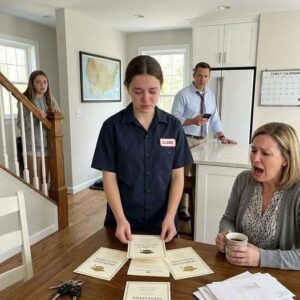
At our family retreat, my mother took a matching navy T-shirt from my hands and said, “These are for people with real families.”
My nine-year-old daughter stood beside me, holding the smaller shirt she had chosen for herself. She had spent the morning asking when we would take the group picture and whether she could stand near the front this year.
My sister laughed from across the lodge dining room.
“You came here alone, Maya. Don’t make this awkward.”
She meant without a husband.
My mother folded both shirts and placed them behind her. Then she told the photographer, “We want the picture to look consistent.”
I looked around at the catered lunch, the welcome bags, and the relatives wearing shirts charged to the retreat account I had funded.
I had also been covering part of my mother’s mortgage and the payment on my sister’s luxury SUV.
Those arrangements had begun as temporary help during separate emergencies.
Somehow, years later, they had become family tradition.
I nodded.
“Understood.”
I took my daughter upstairs, packed our bags, and drove home before the picture was taken.
That night, I removed my card from the lodge balance, ended the mortgage transfer, and stopped the SUV payment scheduled for Monday.
By midnight, my phone showed 86 missed calls.
No one asked whether my daughter was all right.
My mother demanded that I restore the mortgage transfer.
My sister wrote, “You can’t punish the whole family because you’re embarrassed.”
Then my daughter appeared in the hallway with the retreat shirt design she had drawn weeks earlier.“Mom,” she whispered, “were we only invited because you paid?”
That question led me to a hidden financial plan and proof that the insult at the lodge had never been an accident.
Before I tell you what I found and what happened after I stopped paying, tell me what time it is where you are right now and where you are watching from.
I want to see how far this story travels, because what looked like an argument over a T-shirt was really a family system built on silence.
For the first hour home, Harper watched the Wisconsin trees pass without asking for music.
She usually chose our playlist before I left a parking space.
That afternoon, she held her retreat drawing upon her lap while my phone vibrated inside the console.
Each time it did, her shoulders tightened.
At a rest stop, I found messages from my mother, Diane, my sister, Rachel, and six relatives.
One cousin said the photographer had waited.
Another said I had ruined the weekend.
Rachel sent the finished group photograph and placed a laughing emoji over the empty edge where we would have stood.
No one used Harper’s name.
That absence mattered because Harper had tried so hard to belong.
She had saved eight dollars of her allowance for the shirt, practiced smiling without showing the gap between her front teeth, and asked me twice whether the photograph might hang inside Diane’s hallway.
The adults saw one child eager to stand beside them and decided her household would spoil their symmetry.
“Will Grandma lose her house tonight?” Harper asked.
Her fear showed how much she had absorbed from years of family emergencies.
“No. Grandma has income and savings. I was helping. Helping is different from being responsible.”
I needed that distinction too.
Four years earlier, my father took medical leave, and Diane said one missed mortgage payment could destroy everything.
I agreed to transfer $1,200 monthly for six months.
My father returned to work before the sixth transfer.
The payment continued for four years.
Rachel’s SUV payments began after her divorce.
I offered $800 a month for six months while she stabilized.
Thirty months later, she had a promotion, a live-in boyfriend, and two recent vacations.
But I was still paying.
Whenever I asked about an end date, she accused me of measuring love with a calculator.
The lodge followed the same pattern.
I wanted Harper to know her cousins, so I organized the first retreat.
Soon, I was covering deposits, rooms, and shortfalls.
By the third year, relatives waited to hear what I would fund before contributing.
I had called it generosity.
Inside that parked car, I saw that I had trained everyone, including Harper, to believe I was the emergency plan.
At home, Harper folded the retreat schedule until the dates disappeared and dropped it into the trash.
That evening, Rachel sent one of her children to my door carrying a note.
Please don’t take our car.
We need Aunt Maya to stop being mad.
I sent the child home with reassurance that the adults would solve the problem.
Then I called Rachel.
“Do not use a child to collect money from me again.”
“They’re affected by your tantrum.”
“You sent one of them here after laughing while Harper was excluded.”
“She wasn’t excluded. She just wasn’t in the official picture.”
I ended the call.
Seconds later, Diane texted, “Your sister is crying. Is that what you wanted?”
Harper had been silent for hours, and no one had asked why.
After she fell asleep, I listed every recurring family payment.
The total exceeded my own mortgage.
I had postponed repairing our leaking bathroom while financing heated leather seats.
I had reduced my retirement savings so my parents could avoid changing their lifestyle.
At the bottom, I wrote:
Temporary help requires an end date.
I emailed Diane, my father, and Rachel.
I would consider one brief, documented transition, but nothing would resume without complete financial disclosure.
I requested five years of retreat expenses, the SUV balance, and my parents’ household budget.
Diane answered within three minutes.
Family does not audit family.
The following morning, Harper asked whether we were still a family if no one else agreed.
“We were a family before that retreat, and we were one when we left. No shirt decides that.”
She nodded without looking convinced.
I could not repair this with one speech.
I would have to prove that belonging could not be purchased.
My request for records changed the argument.
First, they called me emotional.
Once I asked for numbers, they called me dangerous.
Diane sent a two-page summary with rounded figures and no statements.
My mortgage transfer was labeled a temporary retirement gap, although both of my parents had income.
Lodge expenses appeared as shared family enrichment, with my name missing from the contributor column.
Rachel cropped the SUV payment history from her screenshot.
I replied:
Complete records by Friday.
After that, my decision is final.
On Thursday, my father called.
Robert Collins had spent his marriage pretending silence was neutrality.
At the lodge, he had stared at the floor while Diane took the shirts.
“Your mother says you’re humiliating us.”
“I asked where my money went. Those are not the same thing.”
“Then send the records.”
He paused.
“If I do, things won’t return to normal.”
“Normal ended when you watched them tell Harper she wasn’t real enough for one picture.”
At 1:14 the following morning, his email arrived.
You asked for the truth.
Attached was the original workbook, not Diane’s cleaned PDF.
Robert admitted she had created it five years earlier and that he should have challenged it then.
Two worksheets had been hidden.
The first, Support Schedule, listed every transfer and assigned purposes after the fact.
Mortgage preservation.
Vehicle continuity.
Family gathering stability.
Education reserve protection.
My money had not merely covered emergencies.
It had preserved everybody else’s savings while mine absorbed their costs.
The second sheet, Family Continuity Plan, projected estate gifts and education deposits.
Rachel’s three children appeared with contributions through age 18.
Two cousins’ children received smaller amounts.
Harper’s name was last.
Projected family contribution: zero.
Beside it, in Diane’s initials, was one note:
Maya’s household ends with her.
Direct shared resources toward continuing branches.
My hands shook until the cursor skipped across the screen.
The sheet had been created weeks after my first lodge deposit and two months after the mortgage transfers began.
Diane had not invented her insult at the retreat.
She had put the belief into one formula and maintained it for years.
An archived email chain made it worse.
Diane wrote that my assistance protected funds for grandchildren who would carry the family forward.
Rachel asked whether I might object if I discovered Harper had no account.
Diane answered:
Maya chose an unconventional household.
She cannot expect tradition to rearrange around it.
Robert replied:
I don’t like leaving a child out, but Diane understands the long-term numbers.
He had recognized the harm and surrendered anyway.
I read until dawn.
The file rearranged every memory.
Diane thanking Rachel for giving us “a full table” after I paid for Christmas.
Harper receiving one bookstore card while the other grandchildren got engraved family lockets.
Diane asking me to increase the mortgage help while funding their education accounts.
I had mistaken access for acceptance.
They included us at tables my money expanded, then treated Harper like one guest when the camera appeared.
I printed the workbook, emails, and bank records.
I locked away the originals, changed every linked account, and added one bank security code.
Diane called before breakfast.
“Your father violated my privacy.”
“You kept one ledger of my money.”
“Responsible families plan.”
“Responsible families don’t classify one grandchild as a dead branch while charging her mother for everybody else’s future.”
She argued that Harper would inherit from me.
I reminded her that every other child would inherit from their parents too.
When I asked her to explain continuing branches, she finally said, “You knew your choices were different.”
That was her closest approach to honesty.
Afterward, I cried upon the bathroom floor where Harper could not see me.
I was not grieving the money.
I was grieving years spent performing usefulness for people who had decided usefulness was my only place.
Have you ever discovered that the peace you protected existed only because you paid its price?
I would not demand an account for Harper or bargain for one revised place inside a plan built upon contempt.
I would give the adults one short opportunity to assume their obligations.
Then I would leave the system completely.
I contacted each person separately because group conversations allowed the loudest voice to rewrite events.
First, I called Robert.
I thanked him for sending the workbook, but I said disclosure did not erase participation.
“I thought your mother would soften as Harper got older,” he said.
“You waited for time to do work you refused to do.”
I offered one final mortgage transfer covering three weeks, paid directly to the lender, if both parents signed the date upon which my support ended.
It required no apology.
Only an endpoint.
Robert called it fair.
Diane seized the phone.
“We will not sign one contract with our daughter.”
“Then there will be no transition payment.”
“If we have to touch our retirement savings, that is on you.”
“It is the result of your budget.”
Next, I offered Rachel three direct SUV payments if she signed one end date and confirmed that no child would carry another request.
“You want one confession?”
“I want one end date.”
“You’re controlling everybody because Mom told the truth.”
“What truth?”
“Harper doesn’t have the kind of family my children have.”
Rachel had time to choose those words.
Then she accused me of teaching Harper that money mattered more than love.
“No. You taught her that my money mattered more than her belonging.”
Rachel claimed her children would lose transportation.
I reminded her that she owned one paid-off sedan from her divorce.
She called it unreliable, although I had paid for its recent maintenance.
“You have options. You prefer mine.”
Her boyfriend, Darren, called later.
He knew I had once helped with the SUV but believed the payments had ended the previous year.
Rachel had told him the payments came from one investment.
“She asked me to replace the money and told me not to call you,” he said. “I benefited. I should have asked.”
It was the first acknowledgment without one excuse.
I declined his offer to repay me.
He needed to judge his relationship, not rescue my pride.
The group chat became vicious.
Diane said I was threatening the family home.
Rachel claimed her children were being punished.
One aunt wrote that Harper would carry the guilt if my parents had to move.
I saved screenshots without replying.
I loved Rachel’s children, so guilt still arrived.
Then I separated discomfort from danger.
They had one safe sedan, working parents, and support from their father.
My parents had income, retirement funds, and substantial home equity.
No child faced abandonment.
No adult faced immediate homelessness.
They faced changes they had used my money to avoid.
I still sat with my finger above the payment screen for nearly one minute.
Ending support felt like betraying every promise I had made during their emergencies.
Then I remembered that each promise had included one limit they quietly erased.
Keeping one boundary was not breaking my word.
It was restoring the part of my word they had ignored.
That evening, Harper found the retreat photograph upon my desk.
Somebody had sent it with the message:
Look what your pride made you miss.
“If they think we’re not real, why do they want us at the meeting?”
Diane had demanded that everybody gather on Saturday so I could restore the family arrangements.
“They want the payments back,” I said.
“Can I ask one thing?”
My instinct was to say no.
I would not use her as evidence or make her defend her existence.
“I don’t want to defend it,” she said. “I want them to answer.”
We agreed she could enter for ten minutes, ask one question, and leave with my friend Elena.
She could change her mind at any time.
No one could question, touch, or follow her.
Before bed, Harper wrote something upon one index card and placed it facedown.
I did not read it.
I assembled folders containing the transfers, hidden plan, emails, transition offers, and permanent boundaries.
For once, I was not preparing to persuade them that I deserved kindness.
I was documenting the end of their access.
My parents’ dining room looked like every holiday I had financed.
Coffee and pastries covered the oak table.
The retreat photograph sat inside one silver frame at its center, as though the family’s survival without us was evidence.
Rachel sat beside Darren.
Robert stood near the window.
Diane had invited two aunts and my uncle as witnesses.
When Harper entered, everyone stopped speaking.
Diane reached toward her.
“Come sit with Grandma.”
I stepped between them.
“She has ten minutes. No one questions her or asks her for anything.”
Harper placed her index card atop one automatic-payment authorization Diane had printed for me.
“If Mom and I aren’t one real family, why does our money have to keep your family together?”
No one answered.
Diane opened her mouth, but Harper raised one hand.
“That was my only question.”
She walked out without waiting for permission.
Elena met her inside the den, and they left.
Harper had not asked to be accepted.
She had forced them to hear the contradiction beneath their comfort.
Diane began crying.
“How could you make one child say that?”
“I didn’t write it.”
Rachel said every thought inside Harper’s head came from me.
I placed the workbook upon the table.
“Then explain how your words entered one financial plan when she was four.”
Diane pushed it away.
“This meeting is about preventing one crisis.”
“It is about ending one.”
I distributed the folders.
My aunt reached the phrase continuing branches and looked toward Diane.
“Did Maya know this was private estate planning protected by her own transfers?”
I showed them the flow of money.
While I paid $1,200 monthly toward the mortgage, my parents increased education deposits for other grandchildren.
It was legal.
But they had pleaded hardship, used my support to free their cash, and then directed that cash toward children they considered legitimate.
Diane repeated that Harper would inherit from me.
My uncle asked why Rachel’s children, who also had parents, received both inheritances and family contributions.
“Their households continue the family line,” Diane replied.
There it was without the lodge, shirt, or emotional excuse.
Rachel accused me of twisting numbers because my choices had consequences.
Darren turned toward her.
“Did you know Harper was listed at zero?”
Rachel hesitated.
He moved his chair away.
My uncle pressed her for one answer.
Rachel finally admitted she knew, then said her children deserved more because they came from one complete home.
Darren looked at her as if he were meeting her for the first time.
“And when that complete home needed one car,” I said, “you sent the bill to mine.”
Rachel warned that Harper would grow up knowing I had broken the extended family over one photograph.
“She will grow up knowing I stopped adults from charging admission to her own family.”
Robert sat down.
“I knew,” he said. “I objected once, then allowed it to continue.”
Diane glared at him.
“Don’t perform remorse because she controls the money.”
“That is why we’re here,” he said. “We let Maya’s money matter more than Maya.”
It did not repair his failure, but it broke the wall protecting Diane’s version of events.
I opened my final folder.
“The lodge balance goes to the adults who stayed. The mortgage and SUV support end permanently.”
“Both transition offers expire tonight because neither was accepted in writing.”
Diane pushed the authorization toward me.
“Sign for three months. We can discuss feelings after the house is secure.”
I tore the blank form once and placed both pieces beside the photograph.
Rachel stood.
“You vindictive—”
“Sit down,” Darren said.
I continued.
“No one contacts Harper without permission.”
“No one uses one child to carry messages or request money.”
“No photograph of her will be used to advertise one reconciliation.”
“Future contact requires one apology that names what happened.”
“‘Sorry you were hurt’ is not enough.”
One aunt accused me of dividing everyone.
I handed her the group-chat screenshot where she wrote that Harper would be responsible if Diane lost the house.
“You brought one nine-year-old into the mortgage before I brought her here.”
She looked down.
Rachel told Darren he would need to cover the SUV.
He replied that she had claimed it was paid through her divorce settlement.
“You lied about your debt and Maya’s money.”
Rachel turned toward Diane, but Diane was already arguing with Robert about selling investments.
The people who had acted like one wall began fighting over who would absorb the cost.
The room fractured along every line my payments had concealed.
My uncle stood.
He said he would not attend another retreat until the exclusion was acknowledged.
One aunt followed.
The other turned the framed photograph facedown.
“You’re enjoying this,” Diane whispered.
“I’m relieved you can’t hide behind my generosity. That isn’t the same as enjoying your fear.”
“You’ve become cold.”
“No. I became clear.”
I placed the two shirts Diane had mailed that morning upon the table.
Sending them after losing the payments was her attempt to rename exclusion as one misunderstanding.
“We don’t want one place inside a picture that requires us to finance the frame.”
Outside, Harper waited with Elena.
She did not ask whether they had apologized.
“Did you sign?”
“No.”
She released one breath.
As we drove away, my phone began vibrating.
I turned it off because their panic no longer outranked our peace.
For two days, everyone assumed guilt would make me reverse course.
On Monday, the missing payments became real.
The lodge divided its unpaid balance among the occupied rooms.
Nobody lost one service.
Adults simply received invoices for the weekend they had expected me to finish funding.
Several relatives became quieter when their own cards were charged.
Rachel had rejected the transition offer.
After two late SUV payments, she asked Darren to absorb the loan.
By then, he had reviewed her finances.
She had concealed nearly $20,000 in credit-card debt and one lifestyle supported by my monthly payment.
Darren moved out within three weeks.
He left because Rachel had lied about her debt, my money, and why she expected him to replace it.
Their wedding was canceled.
Rachel sold the SUV before repossession, barely clearing the loan.
Then she returned to the paid-off sedan she had called unsafe.
One mechanic confirmed it needed only routine maintenance.
Without Darren sharing the rent, Rachel left the large townhouse when its lease ended and moved 12 minutes away.
Her children kept their school, meals, and relationships.
Rachel increased her work hours.
Their father adjusted pickups.
One affordable program replaced several expensive activities.
Adults reorganized.
The children remained protected.
Rachel told relatives that I had destroyed her engagement and home.
Darren corrected her once inside the group chat.
Maya ended one car payment.
I ended one relationship because Rachel lied about our finances.
Then he left the conversation.
That cost Rachel more than money.
She had always controlled the family story by speaking first.
Now there were dates, records, and one witness with no reason to defend me.
When she posted the retreat photograph with one caption about betrayal, one cousin commented:
Didn’t Maya pay for this?
Rachel deleted the comment, but not before screenshots spread.
Diane’s consequences took longer.
One financial adviser showed that without my $14,400 annually, my parents could keep their four-bedroom house only through heavier retirement withdrawals or unaffordable refinancing.
The property had high taxes and more space than they needed.
It also served as Diane’s proof that she was the family matriarch.
The adviser recommended downsizing.
Robert agreed.
Diane refused.
For six weeks, they fought over the truth my transfer had postponed.
Their retirement plan protected appearances, not stability.
Robert separated his income and refused to let Diane promise more family money without his consent.
She called it betrayal.
He called it one boundary he should have established years earlier.
Their alliance broke.
Robert moved into one furnished apartment while the house was listed because Diane repeatedly canceled showings without his share entering their joint account.
She could not delay forever.
The house sold four months after the retreat.
They had enough equity to avoid poverty, but after legally separating, each moved modestly.
Robert bought one one-bedroom condominium.
Diane rented one small townhouse.
She did not lose housing.
She lost the house she had used to define respectability.
The annual retreat ended.
My uncle refused to attend another while the continuity plan remained unaddressed.
Two cousins requested old expense records and learned that I had funded much more than anybody knew.
Diane had called my payments “the family fund,” allowing others to assume that she and Robert provided it.
Three relatives apologized specifically for repeating her claims, attacking me over the lodge bill, or dismissing Harper’s exclusion.
I accepted their words without restoring instant closeness.
Others blamed me for exposing private matters.
They wanted permission to judge my boundary without seeing the facts behind it.
Diane had built one public identity around charity luncheons and family unity.
She withdrew from chairing one community fundraiser after two relatives questioned why she had claimed credit for retreats I financed.
I never contacted the committee.
Her own story collapsed beneath documentation.
Her first letter to Harper began:
I’m sorry you misunderstood one difficult adult conversation.
Harper returned it.
“She thinks I heard it wrong.”
I stored it inside the evidence folder.
Age did not entitle anyone to forgiveness.
Stationery did not create sincerity.
Robert’s separate letter said:
I knew it was wrong.
I stayed quiet because disagreement cost comfort.
You did not cause the house sale.
Adults built promises around money that was never ours.
Harper wrote beneath it:
I’m not ready to see you, but you answered the question.
I mailed her reply unchanged.
Rachel never apologized.
She sent one attorney’s demand claiming I had promised to pay until the SUV loan ended.
My attorney answered with messages proving one six-month agreement followed by two voluntary years.
The claim disappeared, leaving Rachel with her legal bill.
I sued no one.
I sought no repayment.
I left the other children’s education accounts untouched.
Revenge did not require taking gifts back.
Each adult simply had to live within the truth of their income, choices, and relationships.
At home, I restored my retirement contribution, repaired our bathroom, and opened one education-and-opportunity account for Harper using less than half of what I had previously sent away.
I also entered therapy because stopping the payments did not stop the instinct behind them.
Whenever I expressed guilt about the sold house, my therapist asked, “Did Diane lose housing, or the housing she preferred?”
I wrote that distinction inside my notebook.
The 86 missed calls became 12.
Then three.
Then none.
Silence had once felt like abandonment.
Now it gave Harper room to laugh without hearing adults debate what my love should cost.
Six months later, Diane sent one second letter.
I treated your family as less real while depending on your mother to preserve mine.
I turned that belief into one plan and expected money to protect me from its cruelty.
My house, retreat, and reputation changed because I refused to change.
Harper kept the letter but requested no visit.
Accountability had appeared.
Forgiveness remained hers to decide.
One year after the retreat, Harper’s school assigned a project called The Shape of Home, about the people and places that created security.
She did not use the retreat picture.
She photographed our repaired bathroom because we had chosen the tile together.
She included the soup pot from the night we came home.
She drew Elena waiting during the family meeting.
At the center, she placed our kitchen table with two chairs pulled out.
Her caption read:
A small family is not a missing family.
During her presentation, Harper said families could be built through birth, choice, trust, or consistent care, and that no shape made another less real.
Her classmates asked ordinary questions about the photographs.
She returned to her seat without applause.
I was grateful.
She no longer had to perform pain so adults could learn.
Robert respected “not yet” for five months before Harper allowed one supervised lunch.
He arrived without gifts.
“I thought staying quiet kept peace,” he told her. “It only kept me comfortable.”
Harper asked whether he still believed a family required one mother and father.
He said no and admitted he was ashamed that consequences had been necessary before he challenged one idea he already knew was wrong.
She allowed another lunch several weeks later.
Trust returned in teaspoons.
Diane did not receive the same access.
Her later messages mixed accountability with excuses regarding her generation and losing the house.
Context could explain one belief.
It could not shift sympathy toward the person who caused the harm.
Rachel remained outside our lives.
The smaller home, older car, and canceled wedding did not make her kinder.
Consequences revealed her.
They did not transform her.
She continued saying, “Maya chose money over family.”
She was partly right.
I chose to stop confusing payments with love.
I chose Harper’s worth over Rachel’s comfort and our future over unity staged for one photograph.
That summer, I used part of the former retreat budget to rent three cabins beside one small lake.
I invited Elena, two cousins who had apologized, their families, and Robert for one afternoon.
Every household paid its share.
There were no required shirts or assigned positions.
During the second morning, Harper spread fabric markers and plain shirts across one picnic table.
Her only rule was that everyone could draw whatever they wanted.
Robert drew one crooked pine tree and waited.
Harper added silver branches.
Mine showed two chairs beneath one kitchen light.
Harper drew different houses joined by one dotted path and wrote:
People can belong without matching.
That afternoon, somebody suggested one photograph.
People wandered toward the dock without being arranged by household.
Harper stood beside me, then invited Robert into the back row.
It was her choice.
He understood the privilege.
One dog crossed the frame when the timer flashed.
Two children looked away.
Elena laughed, and half of the lake disappeared from the photograph.
It became my favorite.
Not because it proved we had replaced anyone.
Because nothing inside it had been purchased as permission.
Later, Harper and I sat at the end of the dock.
“Do you regret paying all those bills?”
I remembered every yes I had given because no appeared to risk our place.
“I regret what I was trying to buy,” I said. “I don’t regret learning that we never needed to buy it.”
Across the water, Robert cleaned the table without being asked.
Elena packed the leftovers.
No one waited for me to solve one emergency.
For years, I believed my family needed my money and I needed their acceptance.
Both beliefs sustained the same system.
When I canceled the payments, I thought I was taking something away.
I was returning their responsibilities and reclaiming mine.
Diane lost the house she used to define success.
Rachel lost one vehicle, one relationship, and the identity she had financed with other people’s trust.
Robert lost the protection of silence and rebuilt connection through action.
Those consequences were not accidents I caused.
They were costs my money had postponed.
Harper and I did not become one real family when relatives apologized or when one new photograph was taken.
We had always been one.
I simply stopped paying people to pretend they agreed.
If your closest relatives offered belonging only while you funded their comfort, would you keep paying for peace or build one peace that never sent you a bill?
We hope this fictional story was both entertaining and meaningful.
It was created only for dramatic storytelling and educational purposes.
We hope it reminds you that not every loss deserves to be mourned forever.
Some losses become blessings once you realize what they save you from repeating.