My name is Linda Meyers. I am thirty years old.
The final gift my mother ever gave me was a choice.
My sister or the door.
I chose the door.
I was eighteen years old. My savings account had just been emptied to zero, and everything I still owned fit inside one backpack.
For five years after that night, nobody inside my family dialed my number.
Then, on a Tuesday in March, Mom called in tears and said the sentence she had apparently been saving.
“Your sister needs you.”
When I finally discovered the real reason behind that call, I sat alone inside my car in a hospital parking lot and laughed until my ribs hurt.
But here is what none of them understood.
The laughter was not the ending.
It was barely the beginning.
Welcome back to Calm Drama Stories, where quiet people finally tell their side.
Stories about family, betrayal, and the moment somebody decides enough is enough.
If you have ever been called the strong one immediately before somebody handed you the bill, this story is for you.
Leave a comment telling me where you are listening from, and subscribe because you will want to hear how this ends.
I grew up inside a two-story house outside Columbus, Ohio.
A cross-stitched sign hung inside the living room.
FAMILY FIRST.
My mother, Carol, had made it herself.
I used to believe it.
It took years before I noticed that the sign never explained which family member came first.
Our home operated through a simple system with two assigned positions.
My sister Vanessa, four years older than me, held the first position.
She was fragile.
The pretty one.
The sensitive one.
The daughter whose feelings could be injured by a weather report.
That position came with full benefits.
I held the other one.
When Vanessa was twelve and knocked Mom’s casserole dish from the counter, I was eight and received the broom.
Nobody needed to announce the arrangement.
It was simply understood.
The way everybody understands which chair belongs to Dad.
When I brought home straight A’s, my report card remained on the refrigerator for approximately three days.
Vanessa’s certificate for participating inside a middle-school choir remained framed inside the hallway for ten years.
I am not saying my parents never loved me.
I am saying their love arrived in one flavor.
Confidence.
Confidence that I would manage.
That I would cope, adjust, absorb, and clean up.
Inside our home, “You are so strong” was never a compliment that stood alone.
I learned to flinch when I heard it.
The way a server flinches when a group of twelve enters the restaurant.
Inside the Meyers family, praise for me always traveled with luggage.
Somebody was about to place something heavy inside my hands.
The compliment was the receipt.
I did not yet understand how heavy that luggage could become.
I learned during the spring I turned eighteen.
At fifteen, I started working a register at Hartman’s Grocery.
Four evenings each week.
Every Saturday.
I had one goal, and it was laminated inside my mind.
Nursing school.
A minor could not open a savings account alone, so Mom joined the account as co-owner.
That detail matters.
Remember it.
For three years, I deposited almost every paycheck.
Birthday money went inside.
Christmas money too.
I skipped a class trip to Chicago and saved that money.
By the spring of my senior year, the balance was $9,300.
I looked at that number the way other girls looked at prom dresses.
Meanwhile, Vanessa was conducting an experiment in the opposite direction.
She enrolled in community college and left after one semester.
She married a long-haul truck driver named Cole one month after meeting him.
At twenty-one, she gave birth to a daughter named Lily.
She separated from Cole before Lily learned to walk.
Vanessa and the baby lived inside an apartment fifteen minutes from my parents.
My parents quietly paid most of her expenses.
The way people pay a bill they are embarrassed to admit exists.
I loved Lily from the first day.
I want that clearly stated.
That tiny girl with serious eyes had no responsibility for what her mother did.
When I was seventeen and a half, I circled a date on my calendar.
My eighteenth birthday.
The morning I could open an account carrying only my name and one required signature.
I was not paranoid.
I had been raised inside that house.
I was fluent in its language.
I planned to transfer every dollar on my birthday.
Mom reached the account nine days earlier.
I learned the truth from an ATM outside Hartman’s after a Thursday shift.
I stopped to deposit my check as usual.
The machine printed a receipt.
AVAILABLE BALANCE: $0.00
I stood there wearing my work polo and read that paper as though it were written in another language.
I inserted my card again and checked twice because an error seemed more believable than the truth.
Then I drove home, entered the kitchen, and placed the receipt upon the table in front of Mom.
She did not pretend to be surprised.
She was drying a cooking pot.
She continued drying it.
Vanessa was four months behind on rent, she explained.
Her car was about to be repossessed.
A mother with a baby could not be without transportation.
Mom used the word family the way other people say obviously.
Dad studied the salt shaker as though it owed him money.
I asked when they intended to tell me.
Mom finally placed down the pot and gave me the expression she reserved for moments when I was being difficult.
Inside our family, difficult meant inconvenient.
She said they intended to explain everything during dinner.
Vanessa was experiencing a crisis.
Crises did not wait for birthdays.
Then Mom spoke the sentence that had controlled my childhood.
The one I could have embroidered from memory.
“You are the strong one, Linda.”
“You will be fine.”
There was no mention of repayment.
None.
That was the detail that reorganized something inside my chest.
Inside their minds, the money had never been a loan.
It had never truly belonged to me.
It was the family’s emergency fund.
I was the family’s emergency employee.
The emergency would always be Vanessa.
I did not scream.
I went upstairs and made telephone calls because even at eighteen, that was who I was.
The bank was polite and useless.
Joint account.
Joint owner.
Every withdrawal perfectly legal.
The woman on the telephone was extremely kind.
People are often kind while handing you nothing.
On Friday morning, I called the police nonemergency number and explained everything.
The officer released the tired sigh of somebody who had heard the same story many times.
“If her name is on the account, it is not theft.”
“There is no crime here, miss.”
“Only family.”
I want to be clear because people always ask why I did not fight.
I fought.
I lost within twenty-four hours because of paperwork my mother had arranged when I was fifteen.
On Saturday, my parents called me downstairs.
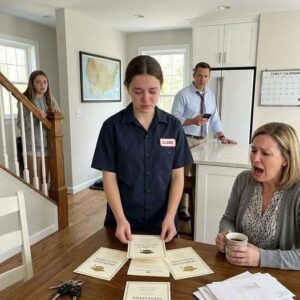
One typed document rested upon the kitchen table.
Dad refused to meet my eyes.
The heading read:
FAMILY LOAN AGREEMENT
But the text beneath it said that the $9,300 had been my voluntary gift to my sister.
Offered freely.
No repayment expected.
It required only my signature.
Mom held out a pen and explained that signing would allow everybody to move forward without unpleasantness.
I asked what would happen if I refused.
Her voice became flat and smooth.
Like a frozen lake.
“Under this roof, we are a family.”
“If you cannot live with that, Linda, there is the door.”
I looked toward Dad.
He looked at the table.
I went upstairs, removed my old backpack from the closet, and began folding.
You would be surprised what survives when an entire life must fit inside one bag.
Two work polos.
Jeans.
My documents inside a plastic folder.
Birth certificate.
Social Security card.
The ATM receipt folded once because some part of me already understood I might someday need evidence that I had not imagined everything.
And one photograph.
Lily at her first birthday.
Cake covering her fists.
Laughing at something outside the frame.
I carried a photograph of my sister’s daughter.
Not one photograph of my sister.
Interpret that however you choose.
I came downstairs.
Nobody was stationed at the door to stop me.
That told me exactly how the scene was expected to end.
I was supposed to become frightened on the porch, return to the kitchen, and sign.
Mom remained inside, wiping a counter that was already clean.
Dad stood inside the garage doorway with both hands in his pockets.
As I passed, he pressed something into my palm without speaking.
Then he turned and studied the lawn mower.
Two folded twenty-dollar bills.
Forty dollars.
That was my father’s entire testimony.
I walked to my car.
Legally mine, thank God.
Purchased used with cash.
Titled only in my name because Hartman’s manager had warned me about situations exactly like this.
I sat behind the steering wheel for one minute and waited to feel something enormous.
Here is what I actually felt.
Quiet.
It had taken my family eighteen years to teach me the lesson, but I finally understood it word for word.
Love inside that house was a bill.
The bill was always addressed to me.
I drove to my coworker Rachel’s apartment and slept upon her sofa.
Nobody called.
Here are the following five years quickly because I refuse to make them sound sadder than they were.
I remained on Rachel’s sofa for six weeks and paid her with groceries.
I completed a six-week certified nursing-assistant course, the cheapest entrance into health care I could find.
I began working inside a rehabilitation facility.
I cleaned handrails and learned that bodies and families fail in remarkably similar ways.
I worked two jobs and completed college prerequisites one course at a time.
At twenty, I entered a two-year nursing program with a partial scholarship and federal loans.
I studied inside break rooms.
I studied inside my car.
At twenty-two, I passed my licensing examination on the first attempt.
I cried inside the testing-center parking lot.
That was the only place I permitted myself to cry during that entire period.
By twenty-three, I worked as a pediatric nurse at a children’s hospital in Columbus.
I had signed a lease for a two-bedroom apartment.
The second bedroom was supposed to become an office.
Remember that.
It matters later.
Now for the other ledger.
During those five years, my family contacted me exactly zero times.
Not on my birthday.
Not at Christmas.
Not when I graduated with my nursing pin and the local newspaper printed my name correctly.
I kept count.
Nurses are good at charting.
I would like to say I healed the deeper wound too.
But honesty is the style here.
I merely moved it.
I became the nurse who covered everybody’s shifts.
I went four years without a proper vacation.
Being needed was the only language of love I had ever learned.
I still spoke it fluently.
I had only changed the people to whom I spoke it.
Then came one Tuesday evening in March.
I was twenty-three.
My telephone rang at 9:40.
The screen displayed a number I had not seen for five years but recognized the way people recognize their own hands.
My parents’ landline.
They were the final two people in Ohio still paying for one, which tells you how they felt about change.
I stood inside my kitchen wearing scrubs and holding tea that had become cold.
I allowed the telephone to ring three times.
Then something older than judgment answered for me.
Mom was crying before I said hello.
Real crying.
I want to be fair.
Her tears were genuine.
Mom’s tears were always genuine.
They were simply never spent on me.
“Linda, thank God.”
“Your sister needs you.”
No hello.
No happy late birthday.
Five birthdays.
No question about whether I was safe.
Whether I had eaten.
Where I lived.
I remained perfectly still and listened to four minutes of weather from a country I had immigrated away from.
Vanessa was in trouble.
Vanessa was overwhelmed.
Vanessa was fragile.
This might destroy Vanessa.
The call concerned my sister, the way every call from that house had always concerned my sister.
My name appeared primarily beside verbs they needed completed.
I noticed my hands were steady.
That frightened me more than the call.
“Needs me for what?” I asked.
Mom’s crying shifted smoothly into the warm managerial tone I remembered from the kitchen.
“Come home Sunday.”
“We will explain everything as a family.”
There it was again.
Family.
Back from the dead and addressed to me as though the previous five years had been a scheduling misunderstanding.
I did not agree.
I asked the question that changed everything.
“Give me the caseworker’s name.”
Silence upon a landline has a particular sound.
Like an entire house holding its breath.
Mom answered too quickly.
It was not that kind of situation.
There had only been a misunderstanding with some agency people.
Agency people.
My stomach understood before my mind did.
This was not about rent.
A child was involved.
I told her good night.
At eight the following morning, on my day off, I contacted Franklin County Children Services and asked for the caseworker assigned to Lily Cole.
Being a pediatric nurse allowed me to navigate that telephone system faster than most people.
I knew the necessary phrases and extensions.
The caseworker was Dana Alvarez.
Her voice belonged to a woman with forty files upon her desk and no time to decorate sentences.
I trusted her within one minute for that reason.
Here was what she was allowed to tell me.
And what Mom had not mentioned.
Three weeks earlier, on Friday evening, Vanessa left six-year-old Lily alone inside her apartment.
She drove to a casino across the county line with a boyfriend.
A neighbor heard a child crying through the wall near midnight and called emergency services.
Police found Lily alone upon the sofa.
The television was on.
She had a box of dry cereal.
Vanessa returned at noon on Saturday.
She was charged with misdemeanor child endangerment as a first offense.
The county opened a case.
Lily had been staying with my parents since then.
I wrote everything on the back of an electricity bill using block letters.
The way a nurse charts a patient she cannot afford to misunderstand.
Then Dana said:
“There is a complication with the grandparents’ home study.”
“Are you calling as a possible placement?”
“I do not know yet what I am calling as.”
I spent two days learning what complication meant.
That was when the laughter began.
The first piece came from Dana.
My parents’ home study had failed.
Not because of age.
Not because of money.
It failed because Vanessa had moved into their house.
Into my old bedroom.
The county required Vanessa, whose contact with Lily was supposed to be supervised, to live somewhere else.
My parents refused.
Mom informed the caseworker in writing that nobody had the authority to remove her daughter from her own home.
Sit with that sentence.
The second piece came during Mom’s next call.
Her voice was sweet as pie filling when she presented the family plan.
“Linda, honey, it is only paperwork.”
“You have the clean record.”
“You have the stable job and the nice apartment.”
“Lily can be registered at your address.”
“The county checks its little boxes.”
“Then everything returns to normal.”
“She stays with us and her mother most of the time.”
“You would barely need to do anything.”
“You are the only person whose background is completely clean.”
“You work inside that world.”
“They will listen to you.”
There was the entire machine.
Displayed under bright light.
If nobody qualified, Lily would enter foster care.
The county’s clock was already running.
My family did not want me back as a daughter.
They wanted an address.
A clean record they could rent.
The way somebody rents a storage unit.
I sat inside my car in the hospital parking lot after a twelve-hour shift.
Then I laughed until my ribs hurt and tears ran from my eyes.
I finally understood the joke.
The clean record was the punchline.
The stable employment.
The spotless background check.
The nursing license.
Every single quality they needed existed because they had thrown me away.
Their punishment had constructed their only escape.
They did not even hear the joke.
If you have ever received that telephone call—the one where relatives suddenly remember your number because they need something—you know that laugh.
It is not happiness.
It is the sound of finally seeing the entire machine.
Tell me in the comments if you have heard it too.
Subscribe because what my family requested next deserves witnesses.
I did not laugh for long.
Somewhere across town, a six-year-old child was sleeping inside a house controlled by the same two roles that had damaged her mother and me from opposite directions.
A county deadline was moving toward a stranger’s spare bedroom.
So on Monday, I called Dana Alvarez back.
I spoke the sentence I had rehearsed inside the shower.
“I would like to be evaluated as a kinship placement.”
“The real version.”
“Complete home study.”
“Background check.”
“No shortcuts.”
I heard her pen stop.
Then I said the second part more slowly because it was the actual decision.
“And anything my relatives tell you, verify directly with me.”
“From now onward, everything I do inside this case happens in daylight.”
Dana remained silent for one moment.
People inside her profession can hear the difference between a volunteer and a recruit.
I think she was deciding which one I was.
Then she began listing requirements in her flat checklist voice.
Fingerprints.
References.
Income verification.
Home inspection.
The list relaxed me.
Rules are fairness with emotion removed.
I had been starving for fairness throughout my life.
Mom called that evening to discover whether I had “come around.”
I said I would do it for Lily.
“The real version,” I clarified.
“Not the paper version.”
Mom released a satisfied breath.
She said she knew I would step forward.
She had told everybody I would.
I had always been the strong one.
I allowed her to keep believing that.
Some people you correct.
Other people you stop translating yourself for.
She heard yes and ended the call happily.
She had no idea we had agreed to two entirely different stories.
Only one could be true.
On Sunday, I drove to the house to see what was at stake.
Five years had passed, and nothing inside had moved.
FAMILY FIRST still hung above the sofa.
Vanessa’s choir certificate remained inside the hallway with its gold sticker fading.
Then my sister crossed the room toward me with both arms extended.
She cried my name as though the previous five years had only been a long journey.
She looked older than twenty-seven around the eyes.
“I always told everybody my little sister would come through.”
She announced the sentence while embracing me.
I stood inside her arms and heard it for what it was.
Not gratitude.
A job opening filled.
Mom glowed at the reunion she intended to describe at church.
Dad held his coffee cup like a man waiting for a bus in bad weather.
At the far end of the sofa, occupying as little space as possible, sat a six-year-old with crossed ankles and both hands inside her lap.
Lily.
She had Vanessa’s coloring and none of her noise.
I watched her throughout the visit.
Here is what a pediatric nurse sees.
A child monitoring every adult inside the room like a tiny air-traffic controller.
Lily poured her own water using a stool somebody had placed beside the sink for exactly that purpose.
She drank.
Washed the glass.
Dried it.
Returned it to the cupboard.
She was six.
Nobody else noticed.
Inside that house, a child’s self-sufficiency was not a warning.
It was convenient.
I recognized her crossed-ankle stillness from old family photographs.
Mine.
When I stood to leave, Lily followed me toward the door.
She remained there gathering courage.
Then, looking at my knees, she asked quietly:
“Are you the aunt with the apartment?”
They had discussed the plan in front of her.
At six, she already knew she was a package awaiting an address.
I crouched.
“Yes.”
“I am your aunt Linda.”
“My apartment has an entire bedroom nobody is using.”
She nodded once, storing the information.
Then she returned to her small place at the end of the sofa.
I drove home performing calculations upon the county’s clock.
Then the county began calculating me.
If you have never completed a kinship home study, here is what it feels like.
Two months of proving to strangers through documents that your life can hold weight.
Fingerprints taken at a state identification office.
Income verified.
Lease copied.
Three references.
None related to me.
That was the easiest requirement because nobody related to me had spoken to me for five years.
A worker inspected my apartment.
Window locks.
Smoke alarms.
She asked where the child would sleep.
I stood inside the doorway of the office that never became an office.
“Her bedroom is here.”
I moved my desk into the living room that weekend.
I transferred from night shifts to day shifts.
I lost the shift differential.
That was the first significant financial cost of the case.
I want it recorded.
I paid without hesitation.
One afternoon, Dana sat across from me at my kitchen table.
She looked up from the clipboard and asked a question that did not appear upon the form.
“Why did you leave home at eighteen?”
I answered directly and briefly.
The savings account.
The document I refused to sign.
The door.
Dana wrote for longer than my explanation lasted.
At the time, I did not know what those notes would become.
I learned during November.
While the paperwork continued, the county approved weekend visits.
That was how I learned who Lily Cole truly was.
On the first Saturday, she entered my apartment carrying her own duffel bag.
She inspected everything like a health inspector.
Quiet.
Thorough.
Touching nothing.
Then she stood inside the kitchen and asked three questions in order.
She must have prepared them during the car ride.
“What food am I allowed to eat?”
I opened one cabinet.
“This shelf belongs to you.”
“Anything marked with a blue sticker may be eaten whenever you want.”
“You do not need to ask.”
“Where do I go when you have visitors?”
“Nowhere.”
“This is your home too.”
“If I have visitors, you are the first person I introduce.”
She turned the answer over like a coin she suspected might be counterfeit.
Then came the third question.
“What happens if I break something?”
There it was.
An entire biography inside one sentence.
I removed a glass from the cupboard and gave it to her.
“Things break.”
“We sweep them up.”
“Nobody receives a broom as punishment.”
Then I handed her a plastic cup.
“This one is unbreakable.”
“The current record for dropping it is eleven times.”
“You may attempt twelve.”
That earned the first almost-smile.
She dropped it nine times before dinner.
Saturday night told me the deeper story.
I opened her bedroom door slightly to check on her.
A nurse’s habit.
She slept upon the made bed.
Not beneath the covers.
Still wearing her daytime clothing.
Her shoes stood side by side against the bed frame.
Toes pointed toward the door.
I remained inside that doorway for a long time.
I understand packed and ready when I see it.
I invented packed and ready.
During her second weekend, I discovered the rest.
It was Sunday morning.
Lily watched cartoons while I vacuumed her room.
The vacuum head struck something beneath the bed.
I knelt and pulled it out.
A small pink backpack.
The kind sold for kindergarten.
Completely packed.
I should not have opened it.
I am glad I did.
Two outfits folded with greater care than most adults use.
A toothbrush inside a sandwich bag.
One box of raisins.
A stuffed rabbit with one ear worn almost to the fabric, placed on top where it could be reached quickly.
She had brought a go bag to her aunt’s home for a weekend visit.
I was still kneeling when I sensed her inside the doorway.
Lily did not panic.
She did not look surprised.
She looked like a child whose teacher had discovered a note.
Resigned to explaining what should have been obvious.
“I keep it packed so it does not hurt when they forget me somewhere.”
Her voice was level.
She recited it like a household rule.
I knelt upon the carpet holding the backpack strap.
Suddenly, I was eighteen again.
Inside an upstairs bedroom, folding two work polos and documents into one bag because the people responsible for keeping me had priced me out.
My backpack marked the end of my childhood.
Lily was six, and hers was already packed.
The same family.
The same luggage.
One generation apart.
I did not turn the carpet into a dramatic scene.
I did not deliver a speech.
A six-year-old with a go bag has no use for either.
I closed the zipper and returned the backpack precisely where I found it.
“All right.”
“We will keep it packed for now.”
“It belongs to you.”
“Nobody touches it.”
“Nobody forgets you here.”
“But keeping or unpacking it will be your decision.”
“Not theirs.”
She studied me.
Then she nodded and returned to her cartoons.
The backpack remained beneath the bed.
Remember it.
This entire story ends with that backpack.
During the following weeks, inside low-stakes hours—hair braiding, cartoons, plastic-cup record attempts—Lily began speaking.
Children talk when their internal radar becomes quiet.
The truth emerged sideways inside crumbs.
The casino night had not been the first.
There had been other “Mommy weekends” since Lily was five when she was responsible for locking the door.
She knew how to prepare three dinners.
Cereal.
Toast.
Cheese sandwiches.
The stove was forbidden when she was alone.
Lily described everything the way she described the backpack.
No drama.
Only logistics.
I sat upon my hands and kept my voice boring.
My questions remained open.
Inside my chest, something was being written with permanent ink.
Here is the thing about my profession.
I am a mandated reporter.
When a child tells a nurse she has repeatedly been left alone overnight at ages five and six, the law does not provide a family exemption.
Here is the thing about me.
Weeks earlier, while listening to Dana’s checklist voice, I had decided:
Daylight or nothing.
On Monday morning, I formally reported the disclosures.
Dana scheduled Lily to meet a child-interview specialist.
A carefully trained professional inside a soft room.
Lily repeated everything using the same logistical tone.
The county amended the case.
Vanessa’s required plan became stricter.
Verified parenting-class attendance.
Supervised contact only.
By June, after my home study cleared, Lily was officially placed inside my apartment.
My telephone began ringing at eleven that evening.
The landline number pulsed upon the screen like a smoke alarm.
I ignored two calls.
I answered the third.
Mom’s voice contained no tears.
“What did you tell them?”
“What kind of sister are you?”
What kind of sister are you?
I wrote that sentence down too.
The collection was growing.
What followed was a two-part campaign I could have mapped in advance because I had watched it operate throughout childhood.
Part One: Honey.
For three days, Mom became pure warmth.
A chicken casserole appeared outside my apartment with a note in her looping handwriting describing how proud she was of the woman I had become.
She sent a picture from the family album.
I was nine, holding one of Vanessa’s old dolls inside one arm and a dustpan in the other.
Mom intended it as nostalgia.
As evidence.
It was better evidence than anything my attorney later discovered.
Even the sweet approach told the truth if you examined what every person inside the image was holding.
Then came Part Two.
Vinegar.
Sunday dinner.
The extended family.
I learned what happened through my cousin Beth, who telephoned afterward and spoke in a whisper.
Mom stood over the pot roast and delivered the official version.
Linda left home at eighteen because she was selfish and broke her parents’ hearts.
Now, by God’s mercy, she had received one opportunity to redeem herself by helping her sister.
Instead, she was feeding the family to the government.
Aunt June nodded.
Two seats away, Dad passed the bread and said nothing.
I want to be honest about what it did to me.
Sitting alone inside my kitchen and imagining that table still hurt.
Twenty-three years old.
A hospital badge.
A license.
An apartment lease.
It still hurt.
But the county had taught me something throughout spring.
Inside my family, whoever told the story owned the truth.
Inside court, the storyteller must swear an oath.
Vanessa visited my apartment once that summer.
Unannounced.
Tuesday evening.
Lily was attending a supervised library program.
Vanessa arrived without makeup.
That shocked me.
She looked flattened.
Older than Mom somehow.
For the first time in my life, my sister sat at my table and spoke something true.
“You think I chose this?”
She stared at her own hands.
“They decided I was helpless when I was ten.”
“You do not remember because you were six and occupied being the opposite thing.”
“Nobody made me finish anything.”
“Not school.”
“Not employment.”
“Not marriage.”
She nodded toward Lily’s picture upon the refrigerator but could not say her daughter’s name.
“At least your role gave you a spine.”
“Mine came with an allowance.”
I remained still.
For the first time, I observed the machine from another angle.
It was the saddest angle yet.
Two girls.
One house.
Two costumes passed down like clothing sizes.
Mine stitched from responsibility.
Hers stitched from helplessness.
Both fitted before either of us could read.
For approximately ten seconds, I nearly reached across the table.
Then Vanessa used the same breath and tired expression to demonstrate why the costume always wins.
“So you owe me.”
Her tone was calm and reasonable.
“Tell the caseworker Friday was the first time.”
“Tell them I had influenza.”
“Not that I went to a casino.”
“They believe nurses.”
“You are one of them.”
“They will accept it from you.”
There it was.
The honest minute had only been an entrance ramp.
“No.”
No explanation attached.
No apology cushioning it.
The older I become, the more I believe that was the first complete sentence of my adult life.
Vanessa stood, collected her purse, and smiled.
A smile I recognized from Mom’s kitchen.
“Then I will need to tell everybody what you have been doing.”
According to the family broadcast that followed, I had been stealing a child to punish my sister out of jealousy.
I allowed the story to move around me.
Then September arrived.
Lily began first grade at the elementary school six blocks from my apartment.
On the second Thursday of the school year, at 2:50 in the afternoon, my telephone rang at work.
The school office.
The employee’s voice was too casual for the sentence.
“Ms. Meyers, we are confirming that Lily was collected early by her mother.”
“That was authorized, correct?”
The nurses’ station seemed to tilt.
It was not authorized.
Vanessa was permitted supervised visits only.
The school possessed the court documents.
But documents inside a folder are only as strong as the newest person working at the front desk.
That afternoon, the employee saw a mother whose name matched the birth certificate and allowed her to leave.
I did not race through the city like somebody inside a film.
I stood inside a supply closet with my heart slamming and followed procedure.
Called Dana.
Called the police nonemergency line.
Provided license plates.
Descriptions.
Used the phrases unauthorized removal and supervised-visitation order.
Then I used the hardest clinical skill I possess.
I waited.
Four hours.
At 6:40, an officer called.
“Located.”
“Both safe.”
“They were inside the food court at Eastland Mall.”
Vanessa had purchased a soft pretzel and a teddy bear.
When officers approached, she appeared genuinely confused by the concern.
Inside her internal weather system, she was only a mother treating her daughter to an afternoon outing.
Never the villain.
That was what made it frightening.
When Lily returned that night, she walked directly past the new teddy bear upon the counter.
She entered her bedroom and emerged holding the pink backpack with both straps.
She hugged it against her chest like a life jacket.
Dana called at nine.
Her checklist voice had acquired something new.
Flat.
Final.
“This changes the timeline, Linda.”
“Temporary placement will not protect her anymore.”
The county moved quickly after the mall.
Vanessa’s visits were restricted to a supervised center for two hours each week.
A monitor remained inside the room.
The school received a new identification card containing photographs of authorized adults.
The principal apologized to me for eleven minutes.
Eventually, I told her the new employee was the least broken part of the entire system.
The important conversation happened at my kitchen table.
Dana opened her folder and explained what temporary truly meant.
I want you to hear it the way I did because this was the fork in the road.
As long as I remained merely a placement, the case remained open.
Open cases breathe.
During each review, Vanessa received another opportunity to perform stability for ninety days.
Every relative possessed standing to petition.
My parents had already asked about returning to “a family arrangement.”
There would be another hearing in spring.
Then another after that.
Lily could spend childhood measured in ninety-day intervals with a backpack beneath the bed, waiting for the weather to change.
Dana squared her folder.
“There is a longer road if you are willing to walk it.”
She meant filing for legal custody myself.
Changing from the county’s temporary address into Lily’s actual court-ordered person.
Petitioner.
Party to the case.
On record and under oath against my own family inside a building containing flags in every room.
I asked what happened to children who remained inside temporary placements.
Dana was silent.
Dana Alvarez was never silent.
“Children like Lily learn to keep the bag packed.”
I looked down the hallway toward Lily’s bedroom.
Some sentences do not persuade you.
They switch on the light inside a room where you were already standing.
Before I tell you what I filed, I need to tell you what that summer sounded like because it was the exhibit nobody entered into evidence.
It sounded like two cereal boxes striking the table each morning because I always gave Lily a choice.
Choosing is a muscle.
Hers had been inside a cast throughout her life.
It sounded like nightmares at two in the morning.
My voice inside the darkness using an old nursing exercise.
“Name five things you can see.”
Her small, furious concentration.
“Lamp.”
“Rabbit.”
“Door.”
“My hand.”
“Your hand.”
It sounded like the first time she laughed aloud.
A cartoon moose, of all things.
A large, unguarded honk that startled us both.
Then Lily looked toward me to discover whether laughing that loudly was permitted.
Whatever she found inside my face, she laughed again.
Louder.
It sounded like her friend Maya from down the hall.
Homework arguments.
Me learning that first-grade spelling lists contain hills worth dying upon.
The backpack remained under the bed.
I kept my promise.
I never touched it.
Neither did Lily.
Both facts mattered.
In August, I heard a sound I had never told anybody about until now.
Lily was speaking with Maya on the telephone, describing her weekend.
“At home, we made pancakes.”
Then she caught herself.
A tiny hesitation inside her mouth.
She corrected it.
“At my aunt’s home.”
Several days later, while talking to the stuffed rabbit as she cleaned her bedroom, she used home again.
This time, she did not correct it.
I stood inside the hallway holding a laundry basket and stopped breathing.
You cannot place that moment inside a court file.
The court file would need to catch up.
In October, I sat inside a legal-aid office smelling of burned coffee.
Across from me was an attorney named Ruth Okafor.
She worked according to a sliding fee scale and wasted no words.
My kind of person.
We filed a petition for legal custody of Lily Cole inside Franklin County Juvenile Court.
Attached to it was my notarized affidavit.
The entire pattern presented in dates and numbers.
No adjectives.
The joint account.
$9,300.
The document I refused to sign at eighteen.
The door.
Five years of silence.
Then the telephone call.
Not a call seeking reconciliation.
A call asking to rent my clean record.
The plan Mom described cheerfully using her own words.
The casino night.
The earlier nights.
The backpack beneath the bed.
Ruth read my draft twice.
Then she looked above her glasses.
“You understand what this does.”
“It is not only testimony about Vanessa.”
“It documents the household.”
“After this is filed, there is no version of the future in which you are the daughter who eventually returns home.”
I would like to say I hesitated.
It would make me seem warmer.
The truth is that I remembered a six-year-old correcting home to my aunt’s home as though she had been caught stealing something.
Then I signed.
I noticed it the way people notice an old scar during cold weather.
This was the second document my family’s story had placed before me.
At eighteen, they gave me a lie and a pen.
Remaining inside the family was the price of signing.
At twenty-three, I picked up my own pen and paid that price in reverse.
The lie would have preserved my position as daughter.
The truth resigned the position permanently.
In triplicate.
Ruth filed the petition on Wednesday.
Copies were served upon Vanessa and, because of the family placement they had been requesting, my parents.
I am told the telephone inside their home began ringing before the envelope reached the kitchen table.
People ask why I refused a quiet arrangement.
Why I did not keep everybody comfortable.
Here is the truth about quiet arrangements inside my family.
I was one for eighteen years.
If you are still listening, you already understand why my signature mattered.
Comment “the packed backpack” if this story is reaching somewhere real inside you.
Subscribe because the hearing was where twelve years of swallowed sentences were finally spoken aloud into a microphone under oath.
My relatives went to war the way respectable families do.
No bullets.
Only narratives.
Aunt June telephoned to explain that suing one’s own blood was a sin she could never imagine committing.
Two cousins stopped following me online.
I survived.
Mom’s church group placed Lily upon its prayer list.
Beth read me the wording.
They asked the Lord to soften the heart of the troubled young woman holding her niece hostage from her rightful family.
Holding Lily hostage.
Using a library card and booster seat.
But the visit that truly hurt arrived one Thursday during late October.
Somebody knocked.
I looked through the peephole.
Dad.
The first time I had seen him in five years.
He refused to enter.
He stood inside the apartment hallway holding his cap between both hands.
His gaze moved past my shoulder toward the children’s drawings upon the refrigerator.
Then he delivered his statement like a man reciting something practiced inside the truck.
“I know what happened with your money was not right.”
Five years.
There it finally was.
At the precise moment when the admission could be exchanged for something.
“But your mother cannot lose two daughters, Linda.”
“Withdraw the affidavit.”
“Settle privately.”
“Keep it inside the family.”
I asked one question.
My voice was level as a countertop.
“Dad, was what you did right or wrong?”
“Yes or no?”
My father was fifty-eight.
He had spent thirty-five years married to the weather system controlling our house.
He looked at my doormat.
“That is not the point.”
There it was.
I thought:
That is exactly, forensically, the point.
As he left, he placed an envelope upon the hallway table.
No letter.
Two twenty-dollar bills.
Forty dollars.
The second installment.
Five years after the first.
My father’s complete vocabulary.
Still not a sentence.
November arrived inside documents.
Ruth and I built the case the way professionals build cases.
Exhibits tabbed.
Timeline clean.
The ATM receipt from five years earlier came from my plastic folder.
Still folded only once.
Ruth held it above her desk and looked at me over her glasses.
“You kept this?”
“I carried it from the house inside my backpack the night I left.”
She placed it behind a tab without another word.
But she began typing faster.
I want to be honest about the cost of constructing that affidavit.
The pages looked clinical.
Writing them was not.
There is a particular pain in converting childhood into numbered paragraphs.
Watching eighteen years shrink into Exhibit C.
Seeing how small the words look.
Remembering how much they weighed.
Some nights, I closed the laptop and remained beneath the shower until the water turned cold.
But my profession offered one strange mercy.
Nurses chart symptoms rather than emotions.
Onset.
Duration.
Frequency.
That happens to be the language courts trust.
I had trained for it for years without understanding why.
One night, deep inside drafting, I passed Lily’s room and stopped as I had during her first weekend.
She slept beneath the covers.
Beneath them.
Blanket at her chin.
One arm hanging beyond the edge with the loose confidence of a child expecting the bed to remain hers in the morning.
Her shoes were inside the closet.
I stood inside the hallway holding laundry while tears ran across my face for one minute.
Then I returned to the laptop and finished the paragraph about the casino.
Progress inside my profession is measured in small things.
Eight days before the hearing, Vanessa hired an attorney.
My parents paid him.
Of course they did.
Money always existed inside that family.
The way water exists somewhere beneath a desert.
It simply never rose upon my side of the property line.
Vanessa’s lawyer called Ruth with a settlement offer.
Ruth translated it from across her desk in the flattest voice possible.
They would grant me uncontested custody immediately.
We could sign the following day.
In exchange, Vanessa’s visitation would become unsupervised at once.
I would withdraw the affidavit completely.
The account.
The door.
The family pattern.
The household.
Everything removed from the public record as though it had never been sworn.
Their language, Ruth explained, was:
The family does not need old stories inside a public file.
I considered it.
I will tell you the truth.
It was not nothing.
Ruth agreed.
Trials are unpredictable.
This agreement gave me custody without rolling the dice.
Lily could become legally mine the following day.
All I needed to do was allow the record to lie about the machine.
Then hand that machine two unsupervised days each week to operate upon a six-year-old child.
I asked Ruth one question.
A nurse’s question.
“When would unsupervised contact begin?”
She examined the proposal immediately.
I saw the trend as clearly as a patient chart.
One ordinary Friday in February.
A treat.
An errand.
A boyfriend.
A casino across the county line.
A first grader locking the door after her mother because those were the rules when she was alone.
A backpack repacked beneath some future bed.
I told Ruth I would answer on Monday.
Then I drove home using the longer route.
That night, I stood beside the stove without cooking anything when the telephone rang.
The house line.
Mom had one remaining card.
She played it beautifully.
No tears this time.
That was how I knew it was the true offensive.
My mother saved her dry voice for closing.
“Linda, sweetheart.”
Sweetheart.
A word she had not aimed toward me since elementary school.
I hated what it did to my chest.
She talked for a long time.
She was skilled because everything she offered was something real that had genuinely been withheld.
“Come home.”
“Sunday dinners.”
“Christmas mornings.”
“You and Lily.”
“Stockings along the railing.”
“Your bedroom is still yours.”
“Vanessa will sign whatever the attorneys request.”
“We can become a family again.”
“All of us.”
“Beginning Thursday.”
“All you need to do is remove the old stories from the file.”
“That is all.”
“Families do not need judges, Linda.”
“They need one person large enough to release the past.”
I stood at the stove, twenty-three years old, gripping the telephone with both hands.
I will tell you the complete truth, although it is the least flattering statement inside this story.
I wanted it.
Every cell inside my body wanted it.
For twelve years, I had stood outside the glass of that family, watching warm light through the kitchen windows.
Now Mom was finally holding the door open.
The room behind her appeared warm.
It was real.
And the price tag hung in the same place it always had.
Truth withdrawn.
The record scrubbed.
The cost of all that warmth forwarded, as always, to the smallest person inside the family.
This time, a six-year-old with a go bag.
Mom spoke my name gently.
The tone used to coax somebody away from a ledge.
“So we will see you Thursday.”
“And you will take care of the paperwork.”
I closed my eyes.
“I will see you Thursday, Mom.”
Then I ended the call before she could hear which sentence I had not spoken.
The rooms where lives change are always less beautiful than people imagine.
Franklin County Juvenile Court.
Thursday.
8:40 in the morning.
Waxed linoleum.
Fluorescent lights with a faint insect-like hum.
An American flag dusty around the fringe.
A hallway of blue plastic chairs holding families experiencing the worst mornings of their years.
Lily remained at school, where six-year-olds belong during hearings.
Maya’s mother had agreed to collect her regardless of the outcome because I prepare for outcomes.
That is the job on our side of the hallway.
Ruth wore gray.
Dana held her folders.
Lily’s guardian ad litem was a retired teacher who had interviewed us twice.
The other side arrived inside a procession I heard before seeing.
Vanessa wore a small floral dress.
I would have wagered money Mom selected it.
One more costume fitted to the role.
Mom arrived inside church clothing.
Chin lifted.
Holding Dad’s arm.
Dad wore the suit reserved for funerals.
Before entering court, we stopped inside a conference room.
The attorneys placed the settlement upon the table for the record one final time.
Formica surface.
Humming ventilation.
The printed agreement perfectly squared before an empty chair.
One pen lying diagonally on top.
Presentational.
The way the false gift agreement had rested upon the kitchen table five years and two lifetimes earlier.
My family always enjoyed setting a table for me.
Mom looked across it.
For one moment, I will grant her this.
Her expression was not strategic.
She was simply asking.
Vanessa’s lawyer cleared his throat.
“Ms. Meyers, have you considered our proposal?”
The vent hummed.
Ruth’s pen hovered above her legal pad.
Everybody waited to discover which daughter had entered the room.
I opened my mouth.
“No.”
“The affidavit remains.”
“Everything I have to say concerning my family will be spoken under oath.”
“In the open.”
“With everybody listening.”
“That is the only form of family conversation I accept now.”
Nobody possessed another move.
You can outmaneuver a scheme.
There is no lever upon somebody who has stopped negotiating inside darkness.
Mom’s face closed like a store at night.
We entered the courtroom.
Juvenile hearings are not television.
No dramatic jury.
Only a tired judge, a court reporter, and the slow machinery of questions.
When my turn came, I raised my hand, swore the oath, and testified the way Ruth trained me and the way I charted throughout my career.
Onset.
Duration.
Frequency.
The joint account.
Date.
The $9,300.
Date.
The gift agreement.
The door.
Date.
Five years without contact.
I listed the birthdays.
Then the telephone call.
The plan to use my address, spoken inside Mom’s own words.
Then Lily.
The casino night from the official file.
The earlier nights from the child interview.
The pink backpack beneath a first grader’s bed, packed with raisins and a rabbit so abandonment would hurt less the next time.
The atmosphere changed when I described the backpack.
It always does.
Large betrayals impress people.
Small logistics of childhood fear bend an entire room at the waist.
Vanessa’s attorney cross-examined me using the family script almost word for word.
I watched the judge recognize how old it was.
“Is it not true that you have resented your sister for years?”
“Is this petition your revenge?”
I allowed the question to rest for one beat.
“If I wanted revenge, I would have stayed away.”
“Staying away was working perfectly.”
Then the script did what I could never have engineered.
It read itself aloud.
Vanessa stood at counsel table despite her attorney gripping her sleeve.
She cried toward the judge, the courtroom, and the flag:
“She is the strong one!”
“She was always supposed to handle everything!”
The gavel came down.
But her words were already inside the record.
My family’s operating system testified openly through its favorite child.
Near the end, the judge removed his glasses.
Then he asked the question beneath every other question.
“Ms. Meyers, you are twenty-three.”
“You are single.”
“You perform shift work.”
“You are beginning your career.”
“Explain why you are asking this court to give you responsibility for a child.”
I looked at Mom for one second.
She sat completely straight with her purse upon her lap like a shield.
I realized I had been waiting twelve years to answer a question she had never asked me.
Then I turned toward the judge.
I answered slowly because I intended to say it once.
“All my life, I was told I was the strong one.”
“Inside my family, strong meant the person who paid.”
“I paid with money.”
“I paid with years.”
“I am finished being strong like that.”
“What Lily needs is not the strong one.”
“She needs something better.”
“I would rather be the person who stays.”
The court reporter’s keys typed the words into permanence.
The silence afterward was the loudest thing my family ever gave me.
Then a chair scraped.
The loudest sound inside the entire story.
Mom stood inside the gallery.
She did not shout.
I would have understood shouting.
She smoothed her church skirt.
Lifted her purse.
Then she spoke inside her dry closing voice.
To me.
To the room.
To the record.
“You were born cold, Linda.”
“Keep the child.”
“You have finally taken everything.”
She walked out.
Dad stood in stages, the way he always moved when following her.
At the door, he turned and looked back once.
I have spent years deciding what was inside that expression.
I settled upon this:
It was an apology precisely the size of forty dollars.
The door closed slowly upon its hydraulic hinge.
No slam.
That house had always preferred quiet exits.
I remained inside my chair with both hands folded.
I did not follow.
You cannot imagine what it cost.
You cannot imagine what it purchased.
I had gained the daughter I would eventually adopt and lost my mother within the same sixty seconds.
Before strangers.
Beneath a dusty flag.
Both permanent.
Both mine.
Everything afterward occurred quickly.
The way the most important phase of surgery is often the quietest.
Lily’s guardian ad litem read her recommendation inside a steady classroom voice.
Placement with the aunt should become permanent.
The child was thriving.
Then she closed the folder and added a sentence I will carry until I die.
“In this observer’s opinion, the child has finally unpacked.”
She might not have understood what she said.
Perhaps she understood completely.
Teachers usually do.
Dana testified to a stable placement and completed home study.
Checklist flat.
When the judge asked for her assessment of me, she read from the long note written at my kitchen table during April.
The note about why I had left home at eighteen.
That was what the note became.
I could have kissed her clipboard.
The judge granted legal custody of Lily Cole to Linda Meyers.
Vanessa’s visitation remained supervised under a written case plan.
A real ladder back if she ever chose to climb.
Classes.
Clean months.
Consistency.
The same ladder offered to every parent inside that building.
I want that clearly stated.
The court left her a door.
So did I.
Some machines must be broken.
People should be given ladders.
Outside, the November sky above Columbus was the color of a nickel.
I sat inside my car in the courthouse parking garage.
The same driver’s seat where I had laughed until my ribs hurt during March.
This time, I cried for approximately ninety seconds.
One hand on the steering wheel.
The other resting upon the folder containing the custody order.
Then I blew my nose.
Made no effort to repair my face.
And drove to Lincoln Elementary because it was 2:40 and the pickup line formed early.
Some doors close inside courtrooms.
The door that mattered was the passenger door of my Honda opening at 2:55 for a child wearing her hood against the drizzle and asking what we were having for dinner.
Here is the aftermath, measured honestly because this channel does not sell miracles.
Vanessa attended the visitation center twice during December.
Once during January, arriving late.
By spring, some months passed without a visit.
I sat inside the center parking lot with Lily’s booster seat in the back, attempting to decide what to say.
Lily often buckled herself in and spoke before I could.
“Mommy forgot again.”
The logistics voice.
Quieter each time.
Then one day, not quieter.
Only finished.
A fact filed beside other facts.
My sister is not a monster.
I need you to hear that from me rather than from the internet.
She is what that house constructed.
A woman assigned helplessness as a job at ten years old.
Nobody required her to complete anything.
So she does not.
The ladder provided by the court remains bolted to the wall.
She has never placed one foot upon it.
Mom sent one card during that first winter.
Cream paper.
Looping handwriting as steady as ever.
When you are prepared to apologize, we are prepared to forgive you.
I read it twice inside the kitchen.
Then I placed it inside the plastic folder I had carried from the house at eighteen.
Directly behind the ATM receipt showing a balance of zero.
The same handwriting appeared throughout the ledger if you knew how to read it.
I never responded.
The invoice finally reached a customer who had closed the account.
Then came an ordinary Tuesday during late spring.
Spaghetti cooked upon the stove.
Spelling homework covered the table.
Lily placed down her pencil, entered her bedroom without speaking, and returned dragging the pink backpack by one strap.
I stopped stirring.
She opened it upon the living-room floor with the focus of a surgeon opening a case.
Then she dismantled it.
The two folded outfits went into the third drawer of her dresser.
The toothbrush left the sandwich bag and entered the bathroom cup.
The raisins went onto her food shelf with the blue stickers.
Last came the rabbit with the worn ear.
He took his new position upon her pillow, facing the door.
Guard duty at last.
Not standby.
Lily hung the empty backpack upon her doorknob.
Then she returned to spelling as though nothing had happened.
I stood beside the stove with the spoon inside my hand and my back toward her for one complete minute.
The rule inside my home is that nobody performs feelings for a seven-year-old.
When I could speak, I said:
“You do not need to become the strong one, Lily.”
“You do not need to become the fragile one either.”
“You only need to be Lily.”
She considered the statement the way children consider something obvious.
“Okay.”
“Can I have more noodles?”
That was the entire ceremony.
Seven years later, I am thirty.
The child who once kept a go bag beneath her bed is thirteen.
She argues with me about screen time as though it were paid employment.
She slams her door over curfew.
She shouts that I am ruining her life.
Every ordinary, defiant, gloriously normal moment is the trophy.
The backpack carries swimming towels now.
She packs it during June for swim season because she chooses to.
That is the entire difference.
It required two generations to purchase.
Twelve years taught me this:
Inside some families, “You are the strong one” is not praise.
It is an invoice.
The day you stop paying is not the day you stop loving your family.
It is the first day you love somebody—including yourself—honestly.
With both eyes open.
With the lights on.
That is my story.
One emptied bank account.
One packed pink backpack.
One sentence finally spoken aloud under oath and entered into the record.
If somebody inside your life calls you the strong one immediately before handing you a bill, take this as your sign.
You are allowed to say no and remain a good person.
If this story felt familiar, share it with somebody who needs it today.
Leave a comment.
Subscribe.
I will see you in the next story.