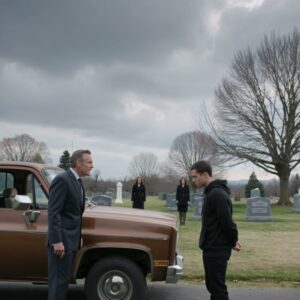
“Would you press the button on your radio and say my name?” my seventy-one-year-old mother asked the deputy who had left her standing beside her Buick in ninety-one-degree heat for forty minutes. We were on County Road 6 in rural Minnesota, halfway to a church ice-cream social, with corn on both sides of us and no shade for a mile. Her temporary driver’s license was a perfectly valid yellow paper issued after her recent renewal, but Deputy Kyle Brandt—twenty-four years old and eleven days into the job—decided it looked “homemade.” He questioned whether she knew the date, mocked the paper, refused to let her sit in the car, and finally announced that he planned to cite her and tow the Buick because he could not verify the license. I had spent those forty minutes seething in the passenger seat while the powdered sugar melted into our pan of lemon bars. Mom never raised her voice. She only asked him to key his microphone and say, “Shirley Hagen.”
Kyle did it because he thought it was funny. “Kessler, Fourteen,” he radioed, joking that a woman with a homemade license wanted him to say her name over the air. For several seconds, nothing came back. Then the dispatcher asked him to repeat the name. Mom leaned toward his shoulder mic and said, “Good afternoon, Kessler. This is Shirley, out on County Six.” The radio changed. One voice after another came through: an older deputy, a firefighter, a medic, a state trooper, a highway worker. Some greeted her. Some thanked her. One man could barely say more than, “You sat on the phone with my wife.” I learned later what I should have understood years earlier. Mom had spent thirty-four years as the county’s overnight 911 dispatcher. She had guided frightened deputies through fatal wrecks, kept snowplow drivers answering through blizzards, trained younger dispatchers through their first unbearable calls, and talked people through emergencies until help arrived. Growing up, I had reduced all of that to the phrase I once used in front of my wife’s parents: “She just answered phones.”
Then the sheriff came over the radio. Tom Hanley asked how long Mom had been standing there, and when Kyle finally admitted, “About forty minutes,” the sheriff ordered him to put her in the air-conditioned car and write nothing. But the final voice belonged to Kyle’s own father, Walt Brandt. He recognized Shirley’s name because in 2009, when a tractor rolled onto him in a dark field, Mom had kept him conscious for fifty-one minutes while directing rescuers to his location using the grain elevator and church steeple as landmarks. Every time Walt began slipping away, she made him talk about his seven-year-old son—Kyle. The rookie deputy sat down on Mom’s bumper and cried. When Sheriff Hanley arrived and started taking away his ticket book and patrol keys, Mom intervened. She did not ask for his firing. She asked for a month of his nights: eleven to seven in the dispatch room, in the second chair beside the current dispatcher, wearing her old headset and listening. “He’s only ever seen people on the side of a road,” she said. “He ought to hear what they sound like when they call for help before he decides anything else about anybody.”The sheriff agreed. That same night, I carried Mom’s battered headset into the dispatch center—a room I had never visited in forty-one years—and watched Kyle sit silently beside Kim while an elderly man called because his wife had fallen behind a bathroom door. Kim’s voice dropped into the same slow, steady register I had heard from my mother all my life: “I’m right here. I’m not going anywhere. Tell me what you see.” A month later, Kyle came to Mom’s porch and told her what the nights had done to him. He described listening to a nine-year-old girl count to one hundred again and again while waiting for an ambulance to reach her unconscious mother. Back on patrol, he had stopped a woman for a broken taillight and noticed she was shaking so badly she dropped her registration. Before his month in dispatch, he would have assumed guilt. This time, he asked whether she needed a minute. She did. Mom told him to keep the old headset in his squad car—not as punishment, but as a reminder.
After Kyle left, I finally told Mom the thing I had been ashamed to admit: “I used to tell people you just answered phones.” She considered it and said, “I did just answer phones. Somebody has to pick up. That’s the whole thing.” Then I told her I had spent years believing she did not care because she missed every Friday-night football game I played. She looked toward the corn and told me she had listened to every one of them on the scanner from the sheriff’s office. Whenever a fight, injury, or emergency came over the air from the field, she held her breath until somebody said my name was not involved. “That’s how I watched you play,” she said. Her permanent plastic license arrived a few days later, but the temporary yellow paper still hangs on her refrigerator beneath a loon magnet beside the old scanner. Sometimes I hear Kim’s voice through it. Sometimes I hear Kyle say, “Kessler, Fourteen,” and Mom stops washing dishes long enough to listen. I call her every Sunday night now. She answers on the first ring. She always did. I was simply not the one calling.