The Second Line
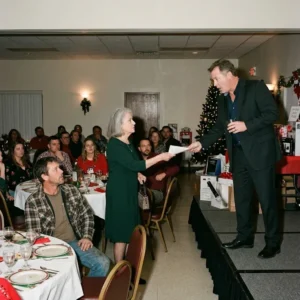
Emma was seven, and she read slowly, with her finger under each word, the way I’d taught her at my kitchen table. The microphone caught every breath.
“Dear Emma. Merry Christmas. This dollhouse is for the girl who deserves a place of her own.” She stopped, and frowned at the card. “And the next part says…”
“Go on, sweetheart,” said Mrs. Ortiz softly.
Emma read the last line. “P.S. Your daddy was returned a gift once too. Ask him about the bike he gave back in 1989.”
Three hundred people sat very still. In the fourth row, my son stood up, and I watched his face. It wasn’t anger. I had written that line to be honest, not to wound, and I’d hoped he would hear it as I meant it. He looked at the stage, and then toward the back of the gym, and then he walked out through the double doors, quickly, with his hand over his mouth.
My name is Patricia Harmon. Everyone calls me Pat. I’m seventy. I taught third grade at Lincoln Elementary in Fort Wayne, Indiana, for thirty-six years, and I know the sound a room makes when a child has said something true into a microphone. It’s a particular quiet, like a held breath.
My husband, Walt, drove a bread truck. He died in 2004, in his sleep, three weeks before Mark’s high school graduation. I raised Mark and his sister Anne alone on a teacher’s salary. I know what $900 is. I know what it looks like when you set it aside forty dollars at a time.
I’d saved since August. A bike for Tyler, a red one with a bell. A dollhouse for Emma, the kind with a staircase. Books. Colored pencils. Things they’d circled in the catalog at my table, with their tongues between their teeth.
You know what Kelsey said. They have enough junk, Pat. And the manicure.
I want to tell you what 1989 was, because it matters, and because Mark had forgotten.
He was seven. Walt had saved for months from overtime and bought him a bicycle, a blue Schwinn, from a shop on Calhoun Street, $64. Mark loved it. He rode it up and down our block until the streetlights came on.
In February, we fell behind on the heating bill. The furnace man came and said he’d shut off the gas Friday. I went to the cupboard. We had $31.
Walt took the bike back. He didn’t tell Mark. He told him it had been stolen. Mark cried for two days. He stood at the window looking at the empty spot in the garage.
I never forgave myself. In the spring I told Mark the truth. He was eight. He looked at me with Walt’s gray eyes and said, “Why didn’t you ask me?”
I’ve thought about that sentence for thirty-seven years.
Mark came back into the gym ten minutes later. I’d stayed in my chair at the back, with my purse in my lap, watching the third graders file off in their paper halos. Mrs. Ortiz had kept the program going. She’s a small woman with silver hair and a voice like a closing door, and she’d calmly announced hot chocolate in the cafeteria.
Parents milled. Somebody’s baby cried. Kelsey stood in the aisle with her coat over her arm and her phone dark in her hand, and a ring of people had formed around her, not close, not hostile. They just stood.
Mark walked toward me down the length of the gym. He’s forty-one, tall, a little soft, with Walt’s jaw and my habit of saying “it’s fine.” He sells insurance. His eyes were red.
“Mom.”
“Hello, honey.”
“Can we talk?”
“Of course.”
He sat in the folding chair beside mine. He put his hands between his knees.
“I remember the bike,” he said.
He didn’t speak for a long time. A janitor stacked chairs with a long metal clatter. Across the gym, Tyler had climbed onto his new bicycle in the middle of the floor, a cautious eight-year-old in a green sweater, and Emma was walking her dollhouse’s front door open and shut.
“I was at the window,” said Mark. “In the garage. I remember the oil stain on the concrete where the front wheel used to be. I looked at it every day.”
“I know.”
“I never told Kelsey about it.”
“Why not?”
“Because it’s the thing I swore I’d never do.” His voice cracked. “Take something from a kid and tell him a story.”
I put my hand over his. It was big and warm and shook.
“Kelsey told you they’d lost the gifts?” I said.
“She said you’d decided not to buy them. That money was tight.” He looked at the floor. “I came home on the twelfth and the tree was bare. I said, ‘Where’s Mom’s stuff?’ She said you’d ‘changed your mind.’”
“Mark.”
“I believed her. I didn’t call you.” He rubbed his face with both hands. “Mom, I’m so sorry. I let her say it. And I stood there at that tree and I felt it again. The window.”
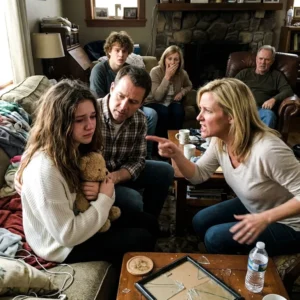
Kelsey came over at that moment. I hadn’t expected it. She crossed the gym slowly in her camel coat, a pretty, composed woman of thirty-eight with long auburn hair, perfect makeup, and a face that had been trained to stay smooth in public. It wasn’t smooth. Her mouth was trembling.
She stopped in front of us.
“Pat.”
“Kelsey.”
“May I sit?”
I moved my purse. She took the chair on my other side. She sat very straight, with her coat folded across her lap, like a woman at a hearing.
“I’d like to say something,” she said. Her voice was thin. “And I’d like to say it here. Not at home.”
“Why here?”
“Because I did it in front of the whole school.” She swallowed. “Mark, don’t. Let me finish.”
He closed his mouth.
“I returned the toys,” said Kelsey. “I took the money to a spa. I told your mother they were junk.”
Nobody spoke.
“I don’t know why I said it. That isn’t true. It’s not what I think.”
“What do you think?” I asked.
She looked at her hands. They were beautifully manicured, with pale pink nails and a diamond. She turned the ring on her finger.
“I think I was jealous,” she said.
I held very still.
“Of you. Of the, of how they look at you. Tyler lights up when you walk in. Emma, she saves her crayon drawings for you.” Her voice shook. “They don’t do that for me. I’m the one who says brush your teeth.”
“Kelsey.”
“I’m so tired, Pat. I work, and I do the lunches, and the laundry, and the carpool. And you come in with cookies, and the whole house goes bright.” She pressed her lips together. “I took the toys because I wanted one thing. To be the person who decided.”
I couldn’t speak.
“I’m ashamed. It’s the worst thing I’ve done.” She wiped her eye with a knuckle, carefully, to save her mascara. “And I’d like to say I’ll pay you back. All of it. Nine hundred.”
“I paid it twice.”
“Then eighteen hundred.”
“Kelsey. It’s a gift.”
“I know,” she whispered. “That’s why I can’t stand it.”
I’d like to tell you I had something wise to say. I sat in a gym, in my good navy coat, with my son’s hand under mine and my daughter-in-law’s shoulder an inch from my own, and thought of a girl on a stool in my kitchen, six years earlier, learning to make a roux.
She’d come to me in her first month of marriage. Pat, teach me to cook. She’d said it shyly, with flour on her cheek. I’d shown her. She’d burned it three times. We’d laughed.
I’d forgotten that. I think she had too.
“Kelsey,” I said. “Did you read my card? The one for Tyler?”
“I did.”
“The last line.”
“‘Ask your mom what a spa day is.’” She laughed, a short, damp sound. “It was fair.”
“It was spiteful.”
“It was a little spiteful.”
“I’d like to take it back.”
She turned. Her eyes were swimming. “Why?”
“Because I wrote it at midnight, and I was angry,” I said, “and I put it in front of three hundred people so you’d feel it. That wasn’t kind.”
She stared at me. Mark, beside me, had gone very still.
“I could’ve called you,” I said. “At the door, on the twelfth. I could have said, ‘Kelsey, that hurt me.’ I didn’t. I went home and planned a stage.”
“I deserved it.”
“You deserved a conversation.”
She put her hand over her mouth. A tear ran down her cheek, and she let it.
“I’ve been so afraid of you,” she said. “For nine years.”
“Of me?”
“You raised two kids alone. You never complain. You’re so, you’re good.” Her voice cracked. “I’d stand in your kitchen and think, I’ll never be that.”
“Oh, honey.”
“And I thought, if I could just once make you look small, I’d feel like I counted.” She laughed, wet. “It didn’t work. I feel about two inches tall.”
I took her hand. It was cold and thin and clung.
“I’m not good,” I said. “I’m stubborn. It’s a different thing.”
We stayed until the gym emptied. I’ll tell you what mattered.
The children found us. Emma climbed into my lap with her new dollhouse key, a tiny brass thing, and said, “Grandma, are you mad at Mommy?”
“I was.”
“Are you still?”
“Less.”
“Are you mad at Daddy?”
I looked at Mark. “No, sweetheart.”
“Why did he go out?”
“Because he remembered something sad.” I smoothed her hair. “Sometimes grown-ups have to go and remember it somewhere quiet.”
Tyler leaned his bicycle against a wall and stood in front of me, a solemn, freckled boy with Walt’s eyes. He held out his card.
“Grandma. I read the P.S.”
“I know.”
“I don’t know what a spa day is.”
Kelsey made a strangled noise. Mark put his head down, and his shoulders shook, and I realized he was laughing.
“It’s a place,” said Kelsey, thickly, “where grown-ups go to rest.”
“Is that bad?”
“No, baby.” She wiped her face. “It’s not bad. It was just the wrong day.”
It took a while. I won’t pretend it was tidy.
On Christmas Eve, Kelsey came to my house. I hadn’t asked her. She stood on my porch at four in the afternoon, in a gray coat with her hair down, no makeup, holding a paper bag. Snow was beginning.
“Pat.”
“Come in, you’ll freeze.”
She stood in my kitchen, looking at the yellow cabinets and the African violets on the sill. She set the bag on the table and took out a rolling pin, a bag of flour, and a stick of butter.
“I’d like a roux lesson,” she said. “If you’d give me one.”
I looked at her. At a woman of thirty-eight, in my kitchen, with a rolling pin she plainly didn’t need.
“You don’t use a rolling pin for a roux.”
“I know. I panicked.” She laughed, shakily. “I brought what I had.”
I took down the cast-iron skillet. I put it on the burner. We stood side by side while the butter melted, and I showed her the color, the pale gold, the nutty smell, and the way you keep stirring until your arm aches.
“Don’t leave it,” I said.
“I won’t.”
“It turns fast.”
“I know.” She stirred. Her jaw was tight. “Pat, I’d like to tell you something about my mother.”
I turned down the flame.
Her mother had taught her one thing, she said. Never let anyone see you need. She’d grown up in a house in Indianapolis where nobody asked for help. Her father left when she was nine. Her mother worked two jobs and ironed Kelsey’s blouses at midnight and never once said she was tired.
“She’d have returned the toys,” said Kelsey, to the skillet. “She’d have said you were showing off.”
“Was I?”
“No.” She stirred. “I think you were just giving. And I didn’t know what that looked like.”
The roux darkened. I handed her the flour sifter. She did it right, with a steady hand, and the kitchen smelled of toast and butter.
“Pat. Why did you buy them again?”
I thought about it. Outside, snow was ticking on the glass.
“Because I’d promised Tyler,” I said. “At my table. In August. I said, ‘You’ll get the red one.’ He said, ‘Really?’ And I said, ‘I promise.’”
“That’s it?”
“It’s the only reason I ever do anything,” I said. “I teach third grade. A promise is the whole job.”
She put down the spoon. She put her arms around me, in my own kitchen, with the skillet smoking behind us.
We did a second Christmas, the twenty-sixth, in my living room. It was small. Mark, Kelsey, the children, my daughter Anne and her husband down from Chicago, and a plate of lopsided sugar cookies.
At the end, Mark handed me a flat package wrapped in the funny pages. I opened it slowly.
It was a framed photograph, black and white, grainy. A boy of seven on a blue bicycle, in a garage, with his mouth open in a joyful shout. In the corner, a young man in coveralls stood with his hands on his hips, watching, grinning.
“Where did you find this?”
“Anne had it. In a box.” Mark’s voice shook. “It’s the day Dad bought it.”
I couldn’t speak. I held it against my chest.
“Turn it over,” said Mark.
On the back, in faded pencil, in Walt’s square hand, were four words.
Best day. Pat’s idea.
I put my hand over my mouth. It had been my idea. I’d forgotten. I’d found the bike in the window, and made Walt go.
“I thought you’d like to know,” said my son, “that it was both of you.”
I laughed. It cracked. Across the room, Kelsey was crying, and Tyler was riding his red bike in slow circles around the coffee table, ringing the bell, and Emma was telling a doll the story of the pageant.
I hung the photograph in my hall, where people come in. I keep the card from the stage in a drawer. I read it sometimes. The last line, the one that sent him out, I’ve decided to keep.
It was true. That’s the only reason I wrote it.